다시듣고 싶어서 오랫동안 음원을 찾았는데 멜론에도 없고 벅스에도 없고... 앨범을 사야하나 그러다 네이버 블로그에서 우연히 오늘 발견.
2018년 1월 29일 월요일

2018년 1월 17일 수요일
2018년 1월 16일 화요일
그리 중요하지 않은
글을 보다 보면 텔레비전을 대부분 television set라고 표현하는 걸 볼 수 있는데 이게 왜 그런지 항상 궁금했다. 그래서 검색해보니, 텔레비전의 본래 명칭이 텔레비전 세트라고.
아마도 텔레비전이 고유명사가 되기 전, 텔레비전, 즉, '멀리 보기 위한 기계 모음'라는 의미로 이 기계 세트를 부르지 않았을까 생각한다. 그게 줄어서 텔레비전이란 고유명사가 된 것이 아닐지.
+ 여기에 좀 더 설득력 있는 커멘트가.
"Remember, TV was a direct descendant of radio. Hobbyists had radio (or "wireless") "sets" that were a collection of distinct components: the battery(s) (often several jars of acid, not the small snap-in "dry cells" we all know today), the receiver, an antenna (another throwback monstrosity: often a clothesline-type affair), headphones, and -- if you wanted to transmit too -- a telegraph key. (Which brings up another point... I would not be surprised if radio borrowed the term "set" from the ye olde non-wireless telegraph, another arrangement that required many separate batteries and a key, at least.)
It's no great leap that the lingo that described these early component radios stuck through the era of the all-in-one radio-in-a-box to the age of the TV-in-a-box.
The real question, IMO, is whether "set" was introduced by early radio (or telegraph) practicioners to describe a collection of components (as in, "I have a new set of batteries") or as a shorthand of the term "setup.""
아마도 텔레비전이 고유명사가 되기 전, 텔레비전, 즉, '멀리 보기 위한 기계 모음'라는 의미로 이 기계 세트를 부르지 않았을까 생각한다. 그게 줄어서 텔레비전이란 고유명사가 된 것이 아닐지.
+ 여기에 좀 더 설득력 있는 커멘트가.
"Remember, TV was a direct descendant of radio. Hobbyists had radio (or "wireless") "sets" that were a collection of distinct components: the battery(s) (often several jars of acid, not the small snap-in "dry cells" we all know today), the receiver, an antenna (another throwback monstrosity: often a clothesline-type affair), headphones, and -- if you wanted to transmit too -- a telegraph key. (Which brings up another point... I would not be surprised if radio borrowed the term "set" from the ye olde non-wireless telegraph, another arrangement that required many separate batteries and a key, at least.)
It's no great leap that the lingo that described these early component radios stuck through the era of the all-in-one radio-in-a-box to the age of the TV-in-a-box.
The real question, IMO, is whether "set" was introduced by early radio (or telegraph) practicioners to describe a collection of components (as in, "I have a new set of batteries") or as a shorthand of the term "setup.""
2018년 1월 13일 토요일
2018년 1월 12일 금요일
J. Nicholas Entrikin, The Betweenness of Place: Towards a Geography of Modernity (1990)
https://www.amazon.com/Betweenness-Place-Towards-Geography-Modernity/dp/0801840848

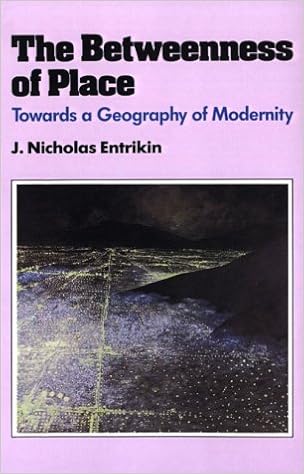
What makes New York City different from Moscow? Are small towns looking more and more alike? What criteria should we use to distinguish onw place from another? Today, geographers and other social scientists are debating not only the answers to these sorts of questions but even whether or not to ask them at all. This ongoing controversy about how (or whether) to study place and its meaning in modern life forms the focus of J. Nicholas Entrikin's pioneering work.
Those who point to a decline in the study of place in geography, Entrikin explains, cite three main causes: the apparent homogenization of world culture; the belief that studying particular places is somehow "parochial"; and the tendency of the scientific method to generalize. Entrikin treats each of these in turn, addressing topics that include the Marxist view of a world economy, the moral implications of place (in such notions as community and provincialism), and the empiricist versus neo-Kantian traditions in philosophy.
To geographers arguing the merits of hard, scientific data versus subjective experience, Entrikin offers a compromise. "To understand place", he suggests, "requires that we have access to both an objective and a subjective reality. From the decentered vantage point of the theoretical scientist, place becomes either location or a set of generic relations and loses much of its significance for human action. From the centered viewpoint of the subjective self, place has meaning only in relation to one's own goals and concerns. Place is best viewed from points in-between."
What makes New York City different from Moscow? Are small towns looking more and more alike? What criteria should we use to distinguish onw place from another? Today, geographers and other social scientists are debating not only the answers to these sorts of questions but even whether or not to ask them at all. This ongoing controversy about how (or whether) to study place and its meaning in modern life forms the focus of J. Nicholas Entrikin's pioneering work.
Those who point to a decline in the study of place in geography, Entrikin explains, cite three main causes: the apparent homogenization of world culture; the belief that studying particular places is somehow "parochial"; and the tendency of the scientific method to generalize. Entrikin treats each of these in turn, addressing topics that include the Marxist view of a world economy, the moral implications of place (in such notions as community and provincialism), and the empiricist versus neo-Kantian traditions in philosophy.
To geographers arguing the merits of hard, scientific data versus subjective experience, Entrikin offers a compromise. "To understand place", he suggests, "requires that we have access to both an objective and a subjective reality. From the decentered vantage point of the theoretical scientist, place becomes either location or a set of generic relations and loses much of its significance for human action. From the centered viewpoint of the subjective self, place has meaning only in relation to one's own goals and concerns. Place is best viewed from points in-between."