
2017년 4월 27일 목요일
오늘의 인용: 할 포스터, 민족지학자로서의 미술가
"하지만 타자와의 환원적인 과잉동일시 또한 바람직하지 않다. 그러나 더 나쁜 것은, 타자를 살해하는 것과 같은 비동일시다. 오늘날 좌우파의 문화정치학은 이러한 궁지에 빠져 있는 듯하다. 좌파는 상당한 정도로 희생자로서의 타자와 과잉동일시를 하고 있는데, 이는 타자를 고통의 위계질서 속에 가두며, 그로 인해서 비참한 자들도 잘못을 저지를 수 있다는 생각을 거의 하지 못하게 된다. 우파는 훨씬 더 상당할 정도로 타자와 비동일시를 하고 있는데, 타자는 희생자로서 이를 비난하지만, 우파는 이러한 비동일시를 이용해서 있지도 않은 공포와 혐오를 만들어내며 정치적 연대를 구축한다. 이렇게 막다른 궁지에 직면하게 된다면, 결국 비판적 거리는 그렇게 나쁜 생각이 아닐지도 모른다."
2017년 4월 26일 수요일
정의당 비판 기사
http://realnews.co.kr/archives/3867
오늘 정의당에 가입했다. 하지만 문재인에게 표를 줄 작정이다. 왜 이렇게 분열적이냐고? 마음에 드는 후보가 없다.
...현재를 민주당에게, 미래를 정의당에게
오늘 정의당에 가입했다. 하지만 문재인에게 표를 줄 작정이다. 왜 이렇게 분열적이냐고? 마음에 드는 후보가 없다.
...현재를 민주당에게, 미래를 정의당에게
2017년 4월 25일 화요일
2017년 4월 23일 일요일
Anna Mccathy, Ambient Television (2003)
"The term site-specific is generally used to describe a certain genre of installation art—work designed solely for a par- ticular place or institution, work that cannot be transplanted elsewhere.1 But it is also a useful term for thinking about the social and spatial opera- tions of the tv set because it focuses attention on the ways in which the audiovisual and material forms of tv blend with the social conventions and power structures of its locale. This property of the tv screen, and the micropolitics it enacts within a site, is extensively documented in histori- cal and ethnographic studies of the domestic tv set, such as Lynn Spigel’s Make Room for TV and David Morley’s Family Television. As these studies show, when the tv set becomes part of the family living room, it not only adapts to the conventional spatial or sensorial arrangements of its loca- tion, but it also enters into, and takes up a position within, the immaterial networks of power that characterize family life."
1장
술집에 텔레비전이 등장 할 때 등장한 커뮤니티와 관람성에 대해 논한다. 티비가 부상하자 술집은 남성성의 장이 됨. 스포츠 경기를 보기 위해 찾아오는 고객들의 요구에 부응하고 술의 회전을 증가시키기 위해 술집 주인이 노력한다. 하지만 티비가 노동 계급 레저가 타락할 수 있다는 근심 걱정을 불러 일으킨다. 특히 바에 어린이들이 찾아와서 텔레비전을 볼 수 있다는 걱정. 때문에 호스트는 주점 관객을 감시하는 전략으로 변경.
2장
백화점의 POP(point-of-purchase) 비디오 광고를 분석, 특히 여성 소비자와 리테일 환경 간의 상관 관계를 분석한다. 거기서 텔레비전의 현전이 몹시 일시적이고 실험적일지라도, 그럼에도 그것은 1940년대 더욱 광범위한 여성성과 소비자 시선gaze의 징후였다. 그리고 예측 불가능한 소비자를 통제하고 자동화하기 위한 판타지 테크놀로지로서의 리테일 공간에서 동시대 비디오 사용을 위한 기초공사였다. 술집에서처럼 백화점에서의 텔레비전은 계급/젠더 정체성과 보는환경 사이의 경영자적이고 대중적인 연결 개념이 어떻게 특정한 관람자 관계를 생산했는지 검토하기 위한 좋은 기회.
3장
1990년대 공항 네트워크. 장소place 기반 미디어가 어떻게 관람자의 신체성과 인구수적 특징을 토포그라피적 의미에서 규정하는지 연구. 이런 장소는 집 밖의 티비 시청자를 모바일하고 엘라스틱한 상품으로 생산한다. 집 안의 시청자를 점점 더 평가절하하면서 1980년대 광고 산업에서 일어났던 시청자 조사의 위기를 극복하려고 애쓴다. 하지만 익명의 여정 사이의 문맥적 관계성을 조사하면서 일상적 주체와 제도적 공간에서, 장소 기반 미디어는 텔레비전 효과의 장소특정적 이론의 한계와 그것이 가지고 있는 모순을 설명함.
4장
텔레비전 콘솔이 공간에서 오브젝트로서 점유하고 있는 공통 물리적 포지션을 검토. 상품 공간의 스펙트럼을 가로질러 다양한 방식으로 공과 사의 개념을 이런 포지션이 어떻게 모양짓는지 주목하면서. 어떻게 겉보기에 눈에 띄지 않는 공공 스크린의 컨벤션--오버헤드 설치, 감시카메라 위치 등--은 관람자의 위치와 place of viewing에 관한 일종의 진술이다. 이것은 더 넓은 지리학에 포함되는데 그 지리학은 공공과 사사, 일과 레저, 소비와 distraction의 지리학. 동시대 공공공간을 규정하는.
5장
티비 세트의 POP의 조각적 컨벤션을 검토. 세일즈 디바이스와 리테일 디스플레이 형태로 비디오를 확장해서 사용하는 것. 티비 이미지를 머천다이즈, 다른 이미지와 오브젝트로 연결시키는 오디오비주얼 디테일을 살펴 봄. 세일즈 포인트에서 티비 광고의 과도한 현전은 동시대 리테일 환경을 규정하는 브랜드 가시성에 관한 기업의 불안을 반영한다.
1장
술집에 텔레비전이 등장 할 때 등장한 커뮤니티와 관람성에 대해 논한다. 티비가 부상하자 술집은 남성성의 장이 됨. 스포츠 경기를 보기 위해 찾아오는 고객들의 요구에 부응하고 술의 회전을 증가시키기 위해 술집 주인이 노력한다. 하지만 티비가 노동 계급 레저가 타락할 수 있다는 근심 걱정을 불러 일으킨다. 특히 바에 어린이들이 찾아와서 텔레비전을 볼 수 있다는 걱정. 때문에 호스트는 주점 관객을 감시하는 전략으로 변경.
2장
백화점의 POP(point-of-purchase) 비디오 광고를 분석, 특히 여성 소비자와 리테일 환경 간의 상관 관계를 분석한다. 거기서 텔레비전의 현전이 몹시 일시적이고 실험적일지라도, 그럼에도 그것은 1940년대 더욱 광범위한 여성성과 소비자 시선gaze의 징후였다. 그리고 예측 불가능한 소비자를 통제하고 자동화하기 위한 판타지 테크놀로지로서의 리테일 공간에서 동시대 비디오 사용을 위한 기초공사였다. 술집에서처럼 백화점에서의 텔레비전은 계급/젠더 정체성과 보는환경 사이의 경영자적이고 대중적인 연결 개념이 어떻게 특정한 관람자 관계를 생산했는지 검토하기 위한 좋은 기회.
3장
1990년대 공항 네트워크. 장소place 기반 미디어가 어떻게 관람자의 신체성과 인구수적 특징을 토포그라피적 의미에서 규정하는지 연구. 이런 장소는 집 밖의 티비 시청자를 모바일하고 엘라스틱한 상품으로 생산한다. 집 안의 시청자를 점점 더 평가절하하면서 1980년대 광고 산업에서 일어났던 시청자 조사의 위기를 극복하려고 애쓴다. 하지만 익명의 여정 사이의 문맥적 관계성을 조사하면서 일상적 주체와 제도적 공간에서, 장소 기반 미디어는 텔레비전 효과의 장소특정적 이론의 한계와 그것이 가지고 있는 모순을 설명함.
4장
텔레비전 콘솔이 공간에서 오브젝트로서 점유하고 있는 공통 물리적 포지션을 검토. 상품 공간의 스펙트럼을 가로질러 다양한 방식으로 공과 사의 개념을 이런 포지션이 어떻게 모양짓는지 주목하면서. 어떻게 겉보기에 눈에 띄지 않는 공공 스크린의 컨벤션--오버헤드 설치, 감시카메라 위치 등--은 관람자의 위치와 place of viewing에 관한 일종의 진술이다. 이것은 더 넓은 지리학에 포함되는데 그 지리학은 공공과 사사, 일과 레저, 소비와 distraction의 지리학. 동시대 공공공간을 규정하는.
5장
티비 세트의 POP의 조각적 컨벤션을 검토. 세일즈 디바이스와 리테일 디스플레이 형태로 비디오를 확장해서 사용하는 것. 티비 이미지를 머천다이즈, 다른 이미지와 오브젝트로 연결시키는 오디오비주얼 디테일을 살펴 봄. 세일즈 포인트에서 티비 광고의 과도한 현전은 동시대 리테일 환경을 규정하는 브랜드 가시성에 관한 기업의 불안을 반영한다.
2017년 4월 14일 금요일
Richard Grusin, Anthropocene Feminism
https://www.amazon.com/gp/product/1517900611/ref=as_li_qf_sp_asin_il_tl?ie=UTF8&tag=criticatheory-20&camp=1789&creative=9325&linkCode=as2&creativeASIN=1517900611&linkId=06ca33924d218fc8a72d907ca0f45201

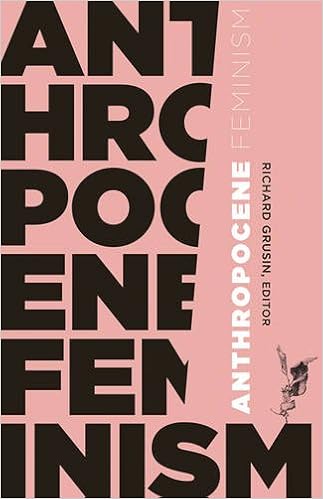
What does feminism have to say to the Anthropocene? How does the concept of the Anthropocene impact feminism? This book is a daring and provocative response to the masculinist and techno-normative approach to the Anthropocene so often taken by technoscientists, artists, humanists, and social scientists. By coining and, for the first time, fully exploring the concept of “anthropocene feminism,” it highlights the alternatives feminism and queer theory can offer for thinking about the Anthropocene.
Feminist theory has long been concerned with the anthropogenic impact of humans, particularly men, on nature. Consequently, the contributors to this volume explore not only what current interest in the Anthropocene might mean for feminism but also what it is that feminist theory can contribute to technoscientific understandings of the Anthropocene. With essays from prominent environmental and feminist scholars on topics ranging from Hawaiian poetry to Foucault to shelled creatures to hypomodernity to posthuman feminism, this book highlights both why we need an anthropocene feminism and why thinking about the Anthropocene must come from feminism.
Contributors: Stacy Alaimo, U of Texas at Arlington; Rosi Braidotti, Utrecht U; Joshua Clover, U of California, Davis; Claire Colebrook, Pennsylvania State U; Dehlia Hannah, Arizona State U; Myra J. Hird, Queen’s U; Lynne Huffer, Emory U; Natalie Jeremijenko, New York U; Elizabeth A. Povinelli, Columbia U; Jill S. Schneiderman, Vassar College; Juliana Spahr, Mills College; Alexander Zahara, Queen’s U.
2017년 4월 13일 목요일
2017년 4월 12일 수요일
Graham Harman: Art Without Relations
https://artreview.com/features/september_2014_graham_harman_relations/
Let’s begin by introducing the term ‘nonrelational aesthetics’. This is not meant as a retort to Nicolas Bourriaud, whose influential book Relational Aesthetics(1998) is not my target. What Bourriaud means by ‘relations’ are staged encounters between humans who would otherwise pass each other anonymously but are now encouraged to interact through jointly cooking packets of soup or other forms of conviviality (as in the artworks of Rirkrit Tiravanija). What I oppose is relationality in a wider sense, one so sufficiently familiar to recent art history that I might seem to be wandering into a long-settled debate. At issue is the independence of artworks not only from their social and political surroundings, their physical settings or their commercial exchange value, but from any other object whatsoever.
Relationality has long had a good press well beyond the arts. Widespread sympathy for dynamic relations over dreary substances marks the general intellectual mood of our time. In recent Continental philosophy, figures from Jacques Derrida and Gilles Deleuze to Isabelle Stengers, Bruno Latour and Jane Bennett are all cited as admirable champions of process and relation over static autonomous things. Yet the claim of object-oriented philosophy, which I advocate, is that the primacy of relations over things is no longer a liberating idea (since it reduces things to their pragmatic impact on humans and on each other).
WIDESPREAD SYMPATHY FOR DYNAMIC RELATIONS OVER DREARY SUBSTANCES MARKS THE GENERAL INTELLECTUAL MOOD OF OUR TIME
Let’s begin with philosophy, whose vocation is to deal with the most universal subject matter. I propose to call this subject matter ‘objects’, in a broad sense that includes human beings along with everything else: copper wire, weather systems, fictional characters, reptiles, artworks, protons, transient events and numbers. Unlike the various special disciplines, philosophy cannot deal with some of these while ignoring the others.
By ‘objects’ I mean unified realities – physical or otherwise – that cannot fully be reduced either downwards to their pieces or upwards to their effects. We know that human and inanimate bodies cannot exist without tiny physical subcomponents. Yet we also know that objects have a certain degree of robust reality that can withstand changes in those components. An object is emergent beyond its subcomponents, and cannot be explained exhaustively by its pieces alone.
But for the arts, as for the social sciences, the greater danger is the upwardreduction that paraphrases objects in terms of their effects rather than their parts. For it is dubious to claim that objects are utterly defined by their context, without any unexpressed private surplus. To defend this view is to commit oneself to a world in which everything is already all that it can be. Change would be impossible if this melon, that city or I myself were nothing more than our current relations with everything else.
EITHER WE EXPLAIN WHAT SOMETHING IS MADE OF, OR WE DESCRIBE ITS EFFECTS
The two reductions differ only in the direction in which they propose to destroy objects: pulverising them into sawdust, or elevating them into an all-devouring context. Admittedly, these are the two basic kinds of knowledge about what something is: either we explain what something is made of, or we describe its effects. But philosophy was never meant to be a form of knowledge. The Greek word philosophia, which means love of wisdom rather than wisdom itself, incorporates a basic ignorance into its etymology.
But if philosophy is not a form of knowledge, the same holds even more obviously for art. An artwork littered with scientific falsehoods might still be better as art than a pedagogical work that inspired young viewers to win a dozen Nobel Prizes. Just as little does art provide the sort of knowledge claimed by social or political explanations. Even a politically provocative work – Picasso’s Guernica (1937), for example – might succeed as art even among those it denounces. The specifically aesthetic handling of the theme might have greater or lesser power than the surface political message of the work, which in turn might be readable in ways that would baffle Picasso himself. Nor can we replace an artwork with its biographical or historical backstory. The art object, taken in a broad sense not restricted to mobile and durable entities, is just as resistant to knowledge as objects in the philosophical sense.
A quiet breakthrough in the theory of objects was made by the phenomenology of Edmund Husserl and Martin Heidegger. One key strategy of the empiricist philosophers was to deny the very existence of objects, replacing them with ‘bundles of qualities’. Strictly speaking there is no such thing as ‘moon’ but only qualities such as ‘white’, ‘round’ and ‘luminous’, which appear together so frequently that we come to use ‘moon’ as a sloppy nickname for this rough set of qualities. The greatness of phenomenology lay in its reversal of this prejudice. For Husserl, ‘moon’ as a unified phenomenal object precedes any particular qualities it might display. The object of experience comes first, and it endures despite considerable ongoing shifts in its evident features. Heidegger raises the stakes by critiquing his teacher Husserl as a philosopher of ‘presence’: although Husserl discovered a unified object of experience, irreducible to its sum of qualities, his objects are exhausted by their presence to the mind. Against this, Heidegger insisted that objects are usually withdrawn into a silent background.
Yet there is something overly holistic about Heidegger’s withdrawn realm of ‘being’, which he opposes not only to beings insofar as they are visible, but also to beings insofar as they are many. This excessive unity of Heidegger’s hidden kingdom of being haunts his famous essay ‘The Origin of the Work of Art’ (1950). Heidegger’s notion of artworks as ‘strife’ between hidden earth and accessible world has not been improved by later philosophers. Yet Heidegger’s ‘earth’ is every bit as unified as his ‘being’, so that every artwork ends up pointing to the same hidden earth in all cases. Whereas normal experience is adrift in a realm of presence, the Heideggerian artwork seems to punch a hole in presence and gesture vaguely towards an irreducible reality-in-itself. Yet the Heideggerian artist is left with a fountain of sensual images in the mind (jugs, temples, peasant shoes) that all hint monotonously at the same earthy background.
WHEREAS NORMAL EXPERIENCE IS ADRIFT IN A REALM OF PRESENCE, THE HEIDEGGERIAN ARTWORK SEEMS TO PUNCH A HOLE IN PRESENCE
Heidegger’s deadlock is roughly the same as that faced by Clement Greenberg in his own theory of modern art. Greenberg’s career-long enemy is academic art, whose chief weakness lies in trying to dupe us with explicit content while paying no heed to the background structure of the medium itself. Famously, modern painting for Greenberg is the kind that comes to terms with its flat canvas background and makes no conces sion to the three-dimensional illusionism dominant from Giotto until Manet. For Greenberg as for Heidegger, the flat background is the same no matter what content is deployed to hint in its direction. In this respect both authors make the surface too shallow and the background too deep, with the artwork’s form conceived too holistically and its content too dismissively.
In defending an art concerned with objects deeper than their relation to humans, it might seem as if we are returning to a high modernist conception of the autonomy of the artwork. And by referring to objects at all, we might seem to be straying in the opposite direction of an observer-centred literalism. In Michael Fried’s canonical 1967 article, ‘Art and Objecthood’, Donald Judd, Robert Morris and their minimalist confederates are famously described as ‘literalists’, since their various oblongs, cubes and rods are supposedly experienced as literal objects rather than in some special aesthetic sense. For Fried, the literal is the same as the theatrical: ‘Literalist sensibility is theatrical because, to begin with, it is concerned with the actual circumstances in which the beholder encounters literalist work.’ In other words, literalist artwork is made with the viewer and the context of viewing in mind. Aesthetics is replaced by spectacle, since the viewer is now anticipated in the structure of the artwork itself.
In a later essay, ‘An Introduction to My Art Criticism’ (1998), Fried provocatively traces the roots of both theatricality and literalism to his estranged and deceased mentor Greenberg. By insisting that modern painting take account of its medium, Greenberg supposedly paves the way to a triumphant final step of presenting blank canvases or naked cubes unadorned with depicted content, despite his preemptive warnings against the emptiness of such a result. Here Fried misreads Greenberg. While the flat canvas background can certainly be treated as a literal physical object, this is not what Greenberg does. Instead, he treats the background as that which never becomes present in its own right and is thus never literal. Greenberg’s flat canvas is not a piece of literal physical material, as it might be for Judd: it is a dematerialised two-dimensional space that all content must take into account in any truly modern, postillusionist painting. To point to the literal physical canvas is not the same as to point to the aesthetic background that the canvas enables.
Yet I am less concerned by the misreading of Greenberg than by Fried’s unfortunate conflation of the literal with the theatrical. On philosophical grounds, I am prepared to agree that the literal should be avoided. Unlike the natural and social sciences – which attempt a literal paraphrase of what objects are by detecting and summarising their qualities – art and philosophy are joined in a love of objects insofar as they cannot be paraphrased. But Fried’s understandable rejection of art as a literal presence of everyday objects is mixed with an admittedly personal revulsion for the theatrical.
The distinction Fried fails to make is that between humans as literalist observers of art and humans as theatrical ingredients of art. As observers and agents, we are literalists who paraphrase the things we encounter in terms of their explicitly detectable qualities, thereby failing to get at the objects beneath these qualities. But as ingredients of the world, we are not literalists or paraphrasers at all, since here we are parts that produce societies, armies, dramas and artworks, just as diamonds or bricks produce other objects.
THE THEATRE IS LESS A SITE FOR OBSERVATION THAN FOR PITY, FEAR AND IMPERSONATION
Another name for the literal is the relational, since both refer to the outward effects of a thing rather than the cryptic inner reality that makes such effects possible. Likewise, another name for the theatrical is the nonrelational, since the theatre is less a site for observation than for pity, fear and impersonation – a place where we do not observe what is portrayed butbecome it, through mimesis in the actor’s rather than the illustrator’s sense of the term. This essay has made two basic claims. First, Heidegger and Greenberg were right to call for a depth behind the surface content of art, but wrong to identify this depth with a unified holistic background. The problem with modernist theory was not that it decontextualised art and made it too autonomous, but that it rooted autonomy in the features of the medium rather than the internal fascinations of content itself. Here Surrealism was an undeserving loser, along with Kandinsky, as in Greenberg’s blatant dismissals of both.
Second, Fried was right to call for an art without literalism, but wrong to see the human as solely a literalising agent. While the artwork must have a depth beyond how it is encountered by the spectator, the human is less a spectator than a co-constituent of the artwork itself, since nonfascinating art simply fails in a way that nonfascinating science does not. The undeserving loser here is not just performance art in the strict sense, but any form of passionate attachment, or ‘sentimentality’ as Fried terms it.
Since Karl Popper recommends that a theory should make risky predictions, let me venture two such predictions here. Among living artists, I will claim that the Russian-born artist Grisha Bruskin, already well known, may be considerably more important than believed. His figures of Soviet and Jewish mythology, arranged somewhat in the fashion of hieroglyphics, display both the inscrutable depth and the theatricality that I have just defended.
As for the dead, I will take an even bigger risk, and suggest that we give a second look to none other than the Dutchman M.C. Escher – the favourite artist of countless children and few respectable adults – for reasons similar to those given in Bruskin’s case. If nothing else, a counterfactual art history in which Escher looms large is a delightful thought experiment.
This article originally appeared in the September 2014 issue
이 글
http://star.ohmynews.com/NWS_Web/OhmyStar/at_pg.aspx?CNTN_CD=A0002315119
이 글은 현실의 유재석과 유느님 캐릭터를 구분하지 못한다. 따라서 유느님의 캐릭터 비판이 어느 순간 유재석 개인의 퍼스널리티 비판이 되는 경향이 있다.
하지만 실제로 현실의 유재석과 유느님이란 캐릭터는 현실에서든 프로그램 상에서든 뒤섞일 수 있다. 이 포인트를 좀 더 정교하게 짚어내는 건 중요해 보인다.
이 글은 현실의 유재석과 유느님 캐릭터를 구분하지 못한다. 따라서 유느님의 캐릭터 비판이 어느 순간 유재석 개인의 퍼스널리티 비판이 되는 경향이 있다.
하지만 실제로 현실의 유재석과 유느님이란 캐릭터는 현실에서든 프로그램 상에서든 뒤섞일 수 있다. 이 포인트를 좀 더 정교하게 짚어내는 건 중요해 보인다.
2017년 4월 7일 금요일
terrain vague
"The photographic images of terrain vague are territorial indications of strangeness itself, and the aesthetic and ethical problems that they pose embrace the problematics of contemporary social life. What is to be done with these enormous voids, with their imprecise limits and vague definition? Art's reaction, as before with "nature" (which is also the presence of the other for the urban citizen), is to preserve these alternative, strange spaces, strangers to the productive efficiency of the city. If in ecology we find the struggle to preserve the unpolluted spaces of a nature mythicized as the unattainable mother, contemporary art seems to fight for the preservation of these other spaces in the interior of the city." Sola-Morales, "Terrain Vague," Anyplace, p. 122.