2015년 12월 31일 목요일

빙과 (2012)
모든 것은 주관성을 잃고 역사적 원근법의 저편에서 고전이 되어간다.
언젠가 현재의 우리도 미래의 누군가의 고전이 되리라.
언젠가 현재의 우리도 미래의 누군가의 고전이 되리라.
-문집 빙과 제 2호 서문에서
일본의 소설 고전부 시리즈를 극화한 애니메이션. 일상물과 미스테리물을 적절하게 섞어놨다. <경계의 저편>을 본 후 교토애니메이션의 작화력에 감동을 먹고 하나 더 찾아본 작품이다. 사스가 실망시키지 않네. 뽕빨 판타지물을 최근에 많이 봤는데 이걸로 치유됐달까. 상기 인용은 극의 활동 무대인 고전부가 매년 내는 문집에 쓰인 서문의 일부 내용이다. 보들레르나 하버마스 같은 사람도 생각나고..여튼 멋들어지는 말이다.
일본의 소설 고전부 시리즈를 극화한 애니메이션. 일상물과 미스테리물을 적절하게 섞어놨다. <경계의 저편>을 본 후 교토애니메이션의 작화력에 감동을 먹고 하나 더 찾아본 작품이다. 사스가 실망시키지 않네. 뽕빨 판타지물을 최근에 많이 봤는데 이걸로 치유됐달까. 상기 인용은 극의 활동 무대인 고전부가 매년 내는 문집에 쓰인 서문의 일부 내용이다. 보들레르나 하버마스 같은 사람도 생각나고..여튼 멋들어지는 말이다.
2015년 12월 30일 수요일
2015년 12월 28일 월요일
2015년 12월 27일 일요일
Above your hand - Annabe, 산카리아 ED
오프닝의 활기, 엔딩의 차분이란 애니메이션 음악의 공식이 존재하는 듯. 산카레이는 내용보다 오히려 엔딩이 눈에 띈다. 머랄까. 캐릭터 이미지에 몰빵한 케이스랄까.
달의 꽃 - nano.ripe, 알바 뛰는 마왕님 ED
설정 비틀기가 주효하게 잘 먹힌, 의외로 재밌게 볼 수 있었던 코미디. 엔딩 노래가 극과 어울리는듯 안 어울리는듯, 조연 비주얼과 함께 어우러지면서 나름 괜춘. nano.ripe은 일본의 인디 모던락 밴드인데, 애니메이션 노래를 많이 불러서 대박난 케이스라고 한다. 여가수 목소리가 코맹맹이인 것에 비해서 실제 비주얼은 반대다. 한국에도 한 번 온적이 있다고.
어제
꿈을 네 번 꿨다. 두 사람이 나왔는데 한 사람 당 두 개의 이어지는 꿈을 꿨다. 한 번은 미움의 감정을 품었고 한 번은 그보다 복잡한 심경을 품었다. 한 사람에게는 왜 나에게 그랬냐고 소리를 고래고래 질렀다. 왠지 원망이 가득했다. 이어지는 꿈에서 나는 그 사람의 젊은 시절을 떠올렸다. 레이스 재질로 연약하게 만들어진 까만 원피스를 보았다. 그 사람은 그 옷을 큰 마음을 먹고 골랐다. 나는 그 옷이 굉장히 멋지다고 생각했다. 언젠가 그 옷을 입을까 말까 고민하던 모습이 기억난다. 이후 그 옷을 이후 입은 걸 본적이 없다.
다른 한 사람에게도 아마 미움의 감정을 품었을 것이다. 그 뒤에 그 사람이 나에게 뭔가를 물어 왔다. 자신이 이렇게 생각하는데 나도 그렇게 생각하는지 따위의 질문이었다. 나는 이 사람이 나에게 왜 이런 질문을 하는지 이해를 할 수 없었지만, 무시할 수도 대답할 수도 없는 것이었다. 단지 계속 그런 생각을 했다.
2015년 12월 26일 토요일
리치맨 푸어우먼 (2012)
무료해서 <리치맨 푸어우먼>이란 일본드라마를 조금 보다가 껐다. 앞머리 답답하게 내린 취준생 여자와 젊은 나이에 성공한 벤처기업 대표의 로맨틱 러브스토리인데, 2012년도에 만들어진 드라마 치고는 너무 허황되고 전형적이라 나같은 니트는 공감하기 어렵달까. ㅎ
사랑 그 쓸쓸함에 대하여 - 양희은, 이병우
양희은의 1991 앨범은 이병우와의 합작이다. 기타 반주 하나가 전체 앨범을 이끌어 가는데 쉼표마저도 연주로 느껴진다는 게 이런 경우 아닌가 싶다.
이병우는 고딩 때 나름 짝사랑했던 미술학원 경리 누나가 소개시켜줘서 알게 됐다. 이리저리 음악 테이프를 교환해서 들었는데, 연주곡을 좋아한다고 하니까 이병우 좋아한다면서 소개시켜줬다. 그땐 그렇게 유명한 사람인줄 모르고 들었다. <내가 그린 기린 그림은> <혼자 갖는 차 시간을 위하여> <생각 없는 생각> 같은 앨범이었던 걸로 기억난다.
2015년 12월 25일 금요일
2015년 12월 24일 목요일
2015년 12월 23일 수요일
끝 이야기 중에서
극중 오노노키짱이 한 말이 찔려서 여기에 옮긴다.
오노노키:
귀신 오빠, 흡혈귀가 되어서 행복해?
초대 괴이죽이기가 그런 말도 했잖아
귀신 오빠가 시노부 선생님과 같이 있는 걸로
내게 무슨 좋은 일이 있냐고
결국 그 자리에 귀신 오빠는 그에게 메리트를 제시하지 못했지만
그 마음은 지금도 변함 없어?
귀신 오빠가 시노부 선생님이랑 함께 있는 걸로
누구도 행복해지지 않는다고 지금도 생각하고 있어?
아라라기:
초대 괴이죽이기가 그런 말도 했잖아
귀신 오빠가 시노부 선생님과 같이 있는 걸로
내게 무슨 좋은 일이 있냐고
결국 그 자리에 귀신 오빠는 그에게 메리트를 제시하지 못했지만
그 마음은 지금도 변함 없어?
귀신 오빠가 시노부 선생님이랑 함께 있는 걸로
누구도 행복해지지 않는다고 지금도 생각하고 있어?
아라라기:
지금도 그렇게 생각해
누구도 행복해지지 않았고 누구도 행복해질 수 없어
내가 흡혈귀인 걸로 내가 시노부랑 같이 있는 걸로
다른 사람들에게는 폐일지도 몰라
누구보다도
시노부를 불행하게 하고 있어
변명처럼도 들리지만 말이야
오노노키:
행복해지지 않으니까 봐주세요
행복해지려고 하지 않으니까 부디 용서해주세요
부디 내버려둬 달라고 말하는 것처럼 들려
우리는 이렇게 불행하니까
책망하지 말라고 불쌍하지 않냐고 하는 것처럼도 들려
저기 귀신 오빠
혹시 당신은 불행이나 불우를 겪고 있는 걸
노력하고 있다고 생각하는 거 아니야?
그런 걸 세간에서는
아무것도 안 하고 있다고 하는 거야
불행해진 정도로 용서 받을 거라고 생각 마
해피엔딩을 노려야지
또 얼굴 밟아줄까?
아라라기:
오노노키는 엄하구나
오노노키:
계속해서 불행한 채로 있는 건 태만이고
행복해지지 않으려는 건 비겁한 거야
그래선 자살한 선구자에게 아무런 보답도 안되잖아
아라라기:
물어봐 둘게
2015년 12월 22일 화요일
어제
어제는 미루고 미루던 일을 하나 처리하고 조용히 술이나 한 잔 할까 하는 생각에 홍대 단골술집으로 향했다. 버스를 타고 가자, 그랬는데 아이고. 멍하게 있다가 반대 방향으로 가는 버스를 타서 대학로까지 갔다. 피곤하기도 하고 해서 다시 버스를 타고 되돌아올 생각은 못하고 그냥 택시를 타고 연남동으로 갔다. 근데 왠걸, 월요일이라 그런지 맨날 가던 술집이 문을 닫았네. 먼가 밖에 나오면 생각대로 잘 안된다 역시.
그냥 조용하게 마시는 건 포기하고 합정동으로 넘어갔다. 후배들이 합정지구에서 무슨 기획을 했는데, 오늘이 무슨 워크샵 날이라고 초청을 했더랬다. 홍대 술집이 문을 닫은 관계로 떠올린 다음 선택지였다. 하지만 의외로 좋았다.
그냥 조용하게 마시는 건 포기하고 합정동으로 넘어갔다. 후배들이 합정지구에서 무슨 기획을 했는데, 오늘이 무슨 워크샵 날이라고 초청을 했더랬다. 홍대 술집이 문을 닫은 관계로 떠올린 다음 선택지였다. 하지만 의외로 좋았다.
입
http://ewsngod.nayana.kr/zexe/12217
이 글은 굿-즈에 이런저런(지지건 비판이건) 관심을 가졌지만 직간접적으로 참여할 기회를 가지지 못했던 사람들의 입이 되준다. 그러니까 '신세대'라는 프레임이 어느정도 짜이고 있는 시기에, 그 사각에 위치한 또래 작가들이 가질 법한 위기감과 불편함, 박탈감이 다소 정직한 언어로 표출됐다고 보는 것이 맞을 거다. 뭔가 '세대'라는 공통지분을 특정 부류가 강탈해서 먹어 치우고 튀어버린 그런 느낌이 드는 것이다.
나머지의 입장에선 최소한 그 지분이 지속적으로 공유되길 바랐겠지만, 굿-즈는 (고)라는 말을 붙임으로써 철저하게 먹튀를 연출했다. 1년 앞을 내다볼 수 없는 시기에 그 결정은 굉장히 합리적이고 심지어 올바르다. 승리자도 몇몇 보인다. 만약 굿-즈가 생명유지장치를 달고 몇년이고 지속된다면 이들이 굿-즈 이외에 할 수 있는 일이 많이 없을지도 모르겠다. 이 사실을 물론 당사자도 알고 있을 것이다. 그런 의미에서 사실 굿-즈의 사망 요인은 자연사가 아니다. 굿-즈 조직자들은 세대적 동력을 활용해 굿-즈를 조직한 후, 그 당사자 세대를 목전에 두고, 그들이 사랑해 마지 않았던(혹은 그렇지 않더라도 반강제적으로 그 중력에 끌려가게 됐던) 굿-즈를 장렬하게 살해했다. 이들은 열렬함과 혼란이 뒤섞인 이 혼탁한 분위기 속에서, 그 누군가가 말했듯이 적당히 "팔아 먹은" 다음에, 신속히 다음 스테이지로 넘어가는 중이다. 매우 명민하게도 말이다.
이 글은 굿-즈에 이런저런(지지건 비판이건) 관심을 가졌지만 직간접적으로 참여할 기회를 가지지 못했던 사람들의 입이 되준다. 그러니까 '신세대'라는 프레임이 어느정도 짜이고 있는 시기에, 그 사각에 위치한 또래 작가들이 가질 법한 위기감과 불편함, 박탈감이 다소 정직한 언어로 표출됐다고 보는 것이 맞을 거다. 뭔가 '세대'라는 공통지분을 특정 부류가 강탈해서 먹어 치우고 튀어버린 그런 느낌이 드는 것이다.
나머지의 입장에선 최소한 그 지분이 지속적으로 공유되길 바랐겠지만, 굿-즈는 (고)라는 말을 붙임으로써 철저하게 먹튀를 연출했다. 1년 앞을 내다볼 수 없는 시기에 그 결정은 굉장히 합리적이고 심지어 올바르다. 승리자도 몇몇 보인다. 만약 굿-즈가 생명유지장치를 달고 몇년이고 지속된다면 이들이 굿-즈 이외에 할 수 있는 일이 많이 없을지도 모르겠다. 이 사실을 물론 당사자도 알고 있을 것이다. 그런 의미에서 사실 굿-즈의 사망 요인은 자연사가 아니다. 굿-즈 조직자들은 세대적 동력을 활용해 굿-즈를 조직한 후, 그 당사자 세대를 목전에 두고, 그들이 사랑해 마지 않았던(혹은 그렇지 않더라도 반강제적으로 그 중력에 끌려가게 됐던) 굿-즈를 장렬하게 살해했다. 이들은 열렬함과 혼란이 뒤섞인 이 혼탁한 분위기 속에서, 그 누군가가 말했듯이 적당히 "팔아 먹은" 다음에, 신속히 다음 스테이지로 넘어가는 중이다. 매우 명민하게도 말이다.
2015년 12월 21일 월요일
2015년 12월 20일 일요일
K (2012)

K는 King의 약자다. 일본(세계?)을 보이지 않게 지배하는 왕의 존재. 왕들이 권력을 찬탈하기 위해 클랜원을 모집하고 서로 싸운다는 이야기. 작화와 액션씬은 훌륭, 설정도 나름 애썼달까. 그 외엔 그냥 쏘쏘. 클램프의 <X> 아류 같기도. 극과 전혀 상관없는 BL 느낌과 여캐 노출이 좀 거슬린다. 일본에선 이런 게 판매 부수에 큰 영향을 주나보다. 중요한 시점을 강조하기 위해서 타임라인을 당김음처럼 쓴달까, 그런 기법을 자주 사용하는데 그냥 의미 없어 보인다. 뮤직비디오에서 캐릭터 이미지를 강조하기 위해서 한 번씩 쓰는 기법 말이다. 막무가내로 "시로(주인공 이름)니까 좋아! 시로니까 믿어!" 이런 말을 남발하는 '네코'라는 멍청한 캐릭터는 일본 만화 단골 손님이긴 한데, 좀 안 나올 수 없는지. 끝.
2015년 12월 19일 토요일
오타쿠의 정신승리
적어도 내가 주로 봤던 애니메이션을 염두에 두고 말하자면, 남성-오타쿠 진영을 소비자층으로 상정한 작품이 많다. 주인공은 대개 평범한 소년-학생-남성인데, 현실에서 평범한듯하지만 사실 특이한 이능의 힘을 가진 탓에 세계평화를 위해 조용하게 살고 있는, 사실 되게 똑똑하고 냉정한 판단력을 가지고 있으며, (사실은) 혈통도 어마무시하고 집도 부자라는 그런 설정으로 종종 등장한다. 그러니까 현실에서 평범하거나 잘 안나가는 건 사실 남주가 다름 평범한 이들과 다르다는 이유 때문이다. 오타쿠들의 마음, 정신승리인 것이다.
남주가 여주와 마주치는 방법은 더욱 오타쿠들의 심리를 반영한달까. 남주는 절대 여자에게 관심을 먼저 표하는 법이 없다. 하지만 상황이 정말 '우연히'도 여성들과의 조우를 강요한다. 갑자기 여러가지 사정으로 인하여 룸메이트로 여성이 배달? 되기도 하고 길가다가 우연히 부딧쳤는데 변태로 오인받기도 하고 사실은 남주를 좋아하는 클래스메이트가 있었으며 기타 등등. 남주는 절대 '원치 않는데도' 불구하고 만남이 반 강제적으로 만들어진다. 가만히 있는데 자꾸 귀찮게 한다는 식이다. 어쩔 수 없이 반응해줘야 한다는 식이다.
오타쿠는 수동적 공격성의 화신이다. 가만히 있지만 가만히 있는 데는 이유가 있다. 내 능력은 이런 같잖은 일에 쓰기 위함이 아니라는 것. 이때 능력을 끌어내는 조건은 '감히' 평범해서는 안되고, 엄청나게 스바라시한 이유여야 한다는 거다. 그게 대마왕이든 공주든 미인이든 어쨌든, 자신의 엄청난 능력은 합당한 이유로 개시되어야 하는 거다. (귀찮겠지만...) 그게 되지 않는 이상, 현실 세계와 담을 쌓거나, 굉장히 신경질적인 반응을 보일 것이다. 아큐 같은 인물에서부터 내려오는 정신승리의 전통.
오타쿠들의 정신적 해리 증상을 비판하고 싶지는 않지만, 결국엔 해소되어야 할 것임에 분명하다. 현실과 가상 사이에 선을 그어버리고 가상 세계에서 살아가는 것에 만족을 느끼는 삶, 그 자체에 대해서 비난할 수는 없다. 누구에게나 행복의 기준은 다르니까 말이다. 하지만 우리는 그들과 분명히 관계맺어야 한다. 어쩌면 그들을 위해서가 아니라 우리 자신을 위해서. 이 이유에 대해선 나중에 써봐야 겠다.
여튼 오타쿠의 수동적 공격성은 반대로 손을 내밀어달라는 긴급한 요청으로도 보인다. 수동적 공격성은 이들의 일종의 리트머스지 같은 것일지도 모른다. 그건 실로 짜증나는 것이지만, 사회적 약자가 에고를 보존하기 위한 일종의 방화벽 같은 것일지도 모른다.
남주가 여주와 마주치는 방법은 더욱 오타쿠들의 심리를 반영한달까. 남주는 절대 여자에게 관심을 먼저 표하는 법이 없다. 하지만 상황이 정말 '우연히'도 여성들과의 조우를 강요한다. 갑자기 여러가지 사정으로 인하여 룸메이트로 여성이 배달? 되기도 하고 길가다가 우연히 부딧쳤는데 변태로 오인받기도 하고 사실은 남주를 좋아하는 클래스메이트가 있었으며 기타 등등. 남주는 절대 '원치 않는데도' 불구하고 만남이 반 강제적으로 만들어진다. 가만히 있는데 자꾸 귀찮게 한다는 식이다. 어쩔 수 없이 반응해줘야 한다는 식이다.
오타쿠는 수동적 공격성의 화신이다. 가만히 있지만 가만히 있는 데는 이유가 있다. 내 능력은 이런 같잖은 일에 쓰기 위함이 아니라는 것. 이때 능력을 끌어내는 조건은 '감히' 평범해서는 안되고, 엄청나게 스바라시한 이유여야 한다는 거다. 그게 대마왕이든 공주든 미인이든 어쨌든, 자신의 엄청난 능력은 합당한 이유로 개시되어야 하는 거다. (귀찮겠지만...) 그게 되지 않는 이상, 현실 세계와 담을 쌓거나, 굉장히 신경질적인 반응을 보일 것이다. 아큐 같은 인물에서부터 내려오는 정신승리의 전통.
오타쿠들의 정신적 해리 증상을 비판하고 싶지는 않지만, 결국엔 해소되어야 할 것임에 분명하다. 현실과 가상 사이에 선을 그어버리고 가상 세계에서 살아가는 것에 만족을 느끼는 삶, 그 자체에 대해서 비난할 수는 없다. 누구에게나 행복의 기준은 다르니까 말이다. 하지만 우리는 그들과 분명히 관계맺어야 한다. 어쩌면 그들을 위해서가 아니라 우리 자신을 위해서. 이 이유에 대해선 나중에 써봐야 겠다.
여튼 오타쿠의 수동적 공격성은 반대로 손을 내밀어달라는 긴급한 요청으로도 보인다. 수동적 공격성은 이들의 일종의 리트머스지 같은 것일지도 모른다. 그건 실로 짜증나는 것이지만, 사회적 약자가 에고를 보존하기 위한 일종의 방화벽 같은 것일지도 모른다.
공전마도사 후보생의 교관 (2015)

★☆ —
그냥 저냥..라노벨 원작이라 설정 자체는 개허접이라 볼 수 없는데 애니 퀄리티로 봤을 땐 그닥. 여캐가 아니라 다 남캐였다고 가정해보자. 이 애니가 아무 것도 보여주는 게 없다는 걸 알게 된다. 모에 장사하는 애니는 좀 그만 나왔으면 좋겠다.
신만이 아는 세계 ~여신편~ (2013)

★★☆ —
그럭저럭 볼만했다. 만화를 원작으로 한 애니메이션으로, 만화는 상당히 인기를 끈 모양이다. 내가 본 건 마지막 3기이지만 전편을 보지 않아도 무난하게 이해가능하다.
현실에서 미연시를 플레이한다면?—이 컨셉이라고 볼 수 있는데, 그러니까 여러 여성의 호감도를 높여 '함락'시키는 것이 남주의 과제로 제시되며, 그 함락된 여성 중에서 가장 적절한(?) 여성과 진심으로 함께 하는 것이 (해피)엔딩이 된다. 그것은 애니메이션의 엔딩과도 같다.
그러니까 함락의 행위 자체는 엔딩이 아니다. 이 세계관에서 그러니까 마지막에 한 여성 캐릭터는 이리저리 자신과 게임을 벌이는 남주에게 그럼 자신과 결혼할 거냐고 되묻는다. 놀이-연애는 현실-결혼으로 완성되어야 한다. 남주는? 알겠다고, 결혼하자고 한다. 하지만 이것이야말로 끝판대장의 클리어 키워드였는데, 결혼 수락과 함께 호감도가 급상승하며 그 여성은 '함락'된다. 그러니까 주인공에 있어 결혼수락발언은 함락시키기 위한 필살기였던 거다.
이 세계관에서 함락된 여성은 주인공과의 기억을 망각하게 된다. 주인공이 애니메이션에서 함락 행위를 끊임없이 수행해도 괜찮도록 만들어 놓은 '현실적'인 설정이다. 하지만 그 설정이 삐그덕 거렸을 때 주인공은 고통 받는다. 현실은 게임처럼 단순하지 않기 때문이다.
2015년 12월 18일 금요일
스트라이크 더 블러드 (2013)

이제부터 반이정 선생처럼 별점을 매겨 볼란다. 이번 점수는요:
★★
장점은 단 하나. 여캐들이 미형이다. 이것저것 떡밥은 많이 던져 놓고 해소를 안 한다. 이런저런 익숙한 설정들이 많다. 예컨대 남주의 덜렁거리는 성격은 금서목록의 남주랑 비슷하다. 의사-성검의 비주얼은 세이버의 엑스칼리버에서 차용한듯하고. 불사의 흡혈귀 설정이나 고답적 말투를 쓰는 로리 캐릭터는 분명히 모노가타리 시리즈로부터 왔고. 등등.
그러니까 전반적으로 진부...진부의 틀을 벗어나지 못한다. 유행어?처럼 특징적으로 반복하는 문구들도 다 진부하다. 주문영창 똑같은 거 반복하는 건 기본이고(톤 하나 안바뀌는데 복붙한 거 아닌가 싶기도) 남주(아카츠키 코죠)가 본격적으로 싸우려고 마음을 먹으면서,
"이제부터 이건 나의 싸움(전장)이다!!" 외칠 때,
"아니에요!!!!" 하면서 여주가 남주 앞에 튀어나 가로막으면서
"이건 '우리'의 싸움이에요!!!"
이럴 때 개짜증..
한 번 할 때는 그런갑다 했는데 계속 유행어처럼 반복하니까 토할 거 같았고.
그런 요소가 몇 개 있었다. 예컨대 남주가 여주에게
미안하다. 나때문에 위기에 말려들게 해서. 힘들었지??
이런 식으로 쓸데없이 사과하는 장면이 있는데, 여기서 여주는 이렇게 말한다.
"전 센빠이의 감시자니까요!!!"
사실 감시자란 말은 핑계고 선배의 여자니까요--를 츤데레로 저렇게 바꿔서 말하는 건데 너무 오글거리고 뻔한 말이랄까. 실패!! 극에서 이걸 시그니쳐로 만들려고 굉장히 노력한다고.
2015년 12월 16일 수요일
평론상
내 예상이 완전히 빗나갔다. (...) 2명의 뉴페이스가 공동수상했는데, 한 분은 트위터에서 박식한 지식을 자랑하시던 horschamp님이었다. 그렇다곤 하더라도 생각보다 나이가 많아서 깜짝 놀랐다. 반이정 평론가 촌평 보면 '글이 잘 안읽힌다'는 지적이 있었는데, 트윗 스타일을 봤을 때 어떤 느낌이었을지 짐작이 가지 않는 바도 아니다.
요즘에 글을 만지면서 들었던 생각을 정리해 본다. 나 또한 잘 읽히는 글. 그러니까 좋은 문장과 문단이 뭔지 꽤 많이 고민하고 극과 극을 많이 왔다갔다 거렸다. 결국 글은 읽혀야 하고 읽히려면 그냥 좋은 주장이나 레퍼런스를 나열하는 것이 아니라 '전달하기'가 필요하다. 그러니까 문장, 글의 스타일, 인터페이스의 문제는 미술에서 형식 문제만큼 중요하다. 인터페이스 그 자체가 사실 정보다. 매클루언의 "미디어는 메시지다"는 말을 따라 하자면.
글은 인용이 많으면 잘 읽히지 않는 것 같다. 너무 구체적이기만 해도 잘 읽히지 않는다. 그리고 너무 개념어들이 많아도 잘 읽히지 않는다. 그냥 자기 글로 풀어 가되, 특별한 어휘나 표현이 원래 있었다는 것을 증거해야 할 경우 직접인용이 주요하다. 그래서 직접인용을 다 빼도 글이 되어야 한다.
구체적인 레퍼런스를 나열하는 것은 정보 차원에서 좋고 때에 따라서 재미를 줄 수도 있지만, 자칫 잘못하면 그냥 정보의 강요, 지식의 과시로만 귀결된다. 다시 말해서 주장이 후경으로 밀려나가고 레퍼런스 과시가 더욱 전경에 올라오게 됨으로써 논리가 흐릿해진다.
개념어들이 많으면 당연히 모든게 추상적이 되거나 엉성해진다. 개념이 많은데 왜 엉성해지느냐. 개념어는 보통 원작자가 책 몇권을 통해 완성한 하나의 개념이기 때문이다. 그걸 몇마디말로 설명하거나 아예 설명도 하지 않고 이리저리 갖다 붙이는 건 잘 하면 현란해보일 수 있으나 대개의 경우 '?'로 끝난다.
요즘에 글을 만지면서 들었던 생각을 정리해 본다. 나 또한 잘 읽히는 글. 그러니까 좋은 문장과 문단이 뭔지 꽤 많이 고민하고 극과 극을 많이 왔다갔다 거렸다. 결국 글은 읽혀야 하고 읽히려면 그냥 좋은 주장이나 레퍼런스를 나열하는 것이 아니라 '전달하기'가 필요하다. 그러니까 문장, 글의 스타일, 인터페이스의 문제는 미술에서 형식 문제만큼 중요하다. 인터페이스 그 자체가 사실 정보다. 매클루언의 "미디어는 메시지다"는 말을 따라 하자면.
글은 인용이 많으면 잘 읽히지 않는 것 같다. 너무 구체적이기만 해도 잘 읽히지 않는다. 그리고 너무 개념어들이 많아도 잘 읽히지 않는다. 그냥 자기 글로 풀어 가되, 특별한 어휘나 표현이 원래 있었다는 것을 증거해야 할 경우 직접인용이 주요하다. 그래서 직접인용을 다 빼도 글이 되어야 한다.
구체적인 레퍼런스를 나열하는 것은 정보 차원에서 좋고 때에 따라서 재미를 줄 수도 있지만, 자칫 잘못하면 그냥 정보의 강요, 지식의 과시로만 귀결된다. 다시 말해서 주장이 후경으로 밀려나가고 레퍼런스 과시가 더욱 전경에 올라오게 됨으로써 논리가 흐릿해진다.
개념어들이 많으면 당연히 모든게 추상적이 되거나 엉성해진다. 개념이 많은데 왜 엉성해지느냐. 개념어는 보통 원작자가 책 몇권을 통해 완성한 하나의 개념이기 때문이다. 그걸 몇마디말로 설명하거나 아예 설명도 하지 않고 이리저리 갖다 붙이는 건 잘 하면 현란해보일 수 있으나 대개의 경우 '?'로 끝난다.
2015년 12월 14일 월요일


2015년 12월 13일 일요일
철학과 미술
미술 이론은 개념의 엄밀함을 따지는 분야가 아닌 것 같다. 물론 엄밀함을 따진다. 하지만 그 강도는 철학에 비할 바가 안된다.
이런 것이다. 사과가 있다. 어떤 컨텍스트에선 사과를 사과라고 부르는 것만으로 충분할 때가 있다. 그런데 어떤 컨텍스트에선 사과의 품종이 중요할 때도 있다. 컨텍스트에 따라서 필요로 하는 정보는 다르다. 만약 '사과가 여기 있어'라는 발화를 하고 다음으로 넘어가야 하는 상황에서 '미국 서부에서 나는 무슨 품종인데 오리지널은 어떤 거고.....'라고 줄줄이 떠들고 있다면 다음 말을 하지 못한다. 말 자체는 둘 다 틀린 말은 아닐 것이다. 하지만 용도는 다르다.
들뢰즈의 화용론 따위를 들먹일 필요도 없이, 어떤 것은 상황에 따라 다른 쓰임새를 가진다. 미술사와 이론에선 개념을 철학적인 깊이까지 사실 다룰 필요가 없다. 더욱 중요한 것은 그것을 가지고 기존 미술과 이론의 내러티브를 어떻게 재구성할 것인지에 관한 거다. 이것을 망각하고 개념을 마구 써댄다면 사이비 철학자 소리를 듣게 될 것이다.
나 또한 예전엔 개념을 설명하는 것이(설명해 내는 것이) 중요하다고 생각했던 것 같다. 왜냐면 스스로도 불확실하기 때문에 제대로 알고 있다고 말하고 싶었던 것일지도 모른다. 하지만 지금은 좀 그렇지 않다. 이 개념이 이런 뜻이라고 말하는 방식보단, 어떤 개념이 어떻게 작동할 수 있을지에 더욱 관심이 가는 편이다.
그러니까 지식을 꿰고 줄줄이 레퍼런스를 늘어 놓는 것 그 자체는 부지런한 사람이라면 가능하다. 하지만 개념에 대해 어떤 입장을 내는 건 조금 다른 일일지도 모르겠다. 심지어 그 개념이 다른 분야에서 수입된 것이라면, 입장은 자신의 분야로부터 나와야 할 것이다.
백남준, 글로벌 그루브와 비디오 공동시장 (1973)
1970년에 쓰여진 “글로벌 그루브와 비디오 공동시장”이란 에세이에서 백남준은 당대 비디오 문화를 “우주선 지구호에 실린 ‘비디오 랜드’”에 비유했다. 이런 테마파크의 비유는 명백하게 (마샬 매클루언의 유명한 용어 ‘지구촌’을 상기시키는) ‘지구호’와 대조를 이루는데, 이때 백남준이 문제삼은 것은 비디오 랜드가 전지구적인 규모로 분열되어 있다는 점이었다. 백남준이 보기에 세계의 방송국이 막대한 비용을 들여 프로그램을 생산해내고 있음에도 불구하고 시청자가 그것에 접근하기는 용이치 않았다. ("우리가 프랑스 텔레비전을 마지막으로 본 적이 언제인가?!") 그는 이런 상황을 1930년대 서구의 배타적 경제체제, 심지어는 파시즘과 비견될 수 있다고 하면서, 공영 텔레비전이 세계 평화와 지구 보존에 힘써야 한다고 역설했다. 그리고 이때 백남준이 제시한 해법은 다름 아닌 비디오 문화에 자유무역시장의 정신과 기능을 도입하는 것이었다. (백남준은 이 글에서 유럽경제공동체를 보고 배워야 한다고 주장했다. 지금 말하면 FTA 같은 걸텐데.)
비디오 문화의 자유시장화, 즉 비디오 공동시장이 세계의 평화와 보존을 약속한다는 백남준의 견해는 다소 뜬금없이 들린다. 하지만 당시 텔레비전 방송의 편파적 보도와 제한된 접근성으로 인한 “정보의 결핍”이 이미 심각한 수준에 이르렀으며, 백남준은 그런 ‘단방향 통신’이야말로 베트남 전쟁과 같은 파국적 결말을 이끈 장본인이라고 보았다. 따라서 백남준은 정보 채널의 전지구적 개방을 통해서 세계 평화가 가능하다고 생각했던 것이다. 이때 비디오 문화는 예술이란 범주에 제한되지 않았는데, 오히려 백남준은 비디오 공동시장의 기획을 위해서 더욱 빠른 자본의 회전이 필요하다고 하며, 심지어 그것이 가능할 때 예술과 “세계평화”가 상품성을 띤 생생한 것이 된다고 했다.
비디오 문화의 자유시장화, 즉 비디오 공동시장이 세계의 평화와 보존을 약속한다는 백남준의 견해는 다소 뜬금없이 들린다. 하지만 당시 텔레비전 방송의 편파적 보도와 제한된 접근성으로 인한 “정보의 결핍”이 이미 심각한 수준에 이르렀으며, 백남준은 그런 ‘단방향 통신’이야말로 베트남 전쟁과 같은 파국적 결말을 이끈 장본인이라고 보았다. 따라서 백남준은 정보 채널의 전지구적 개방을 통해서 세계 평화가 가능하다고 생각했던 것이다. 이때 비디오 문화는 예술이란 범주에 제한되지 않았는데, 오히려 백남준은 비디오 공동시장의 기획을 위해서 더욱 빠른 자본의 회전이 필요하다고 하며, 심지어 그것이 가능할 때 예술과 “세계평화”가 상품성을 띤 생생한 것이 된다고 했다.
백남준은 이것을 미디어 이론가 벅민스터 풀러의 말을 빌려 ‘생태학’이란 말로 압축했다. 풀러에 의하면 “경제라는 용어의 기원은 그 자체가 생태학, 즉 주거를 근본으로 하는 삶의 기술에 있다. 우리가 강조하는 것은 주거조건이 아니라 삶에 대한 총체적인 탐구이며 기획이다.”
Gene Youngblood, "The Artist as Ecologist", Expanded Cinema (1970). pp.345-349
For some years now the activity of the artist in our society has been trending more toward the function of the ecologist: one who deals with environmental relationships. Ecology is defined as the totality or pattern of relations between organisms and their environment. Thus the act of creation for the new artist is not so much the invention of new objects as the revelation of previously unrecognized relationships between existing phenomena, both physical and metaphysical. So we find that ecology is art in the most fundamental and pragmatic sense, expanding our apprehension of reality.
Artists and scientists rearrange the environment to the advantage of society. Moreover, we find that all the arts and sciences have moved along an evolutionary path whose milestones are Form, Structure, and Place. In fact, man's total development as a sentient being can be said to follow from initial concerns with Form or surface appearances, to an examination of the Structure of forms, and finally to a desire to comprehend the totality of relationships between forms, that is, Places. Since it generally is thought that art represents the avant-garde of human insight, it is interesting to note that science itself has evolved through Form, Structure, and Place appreciably in advance of the arts.
The conception of the principle of the atom by the Epicureans in Greece approximately 2,000 years ago began that stage of science chiefly concerned with Form, which included the contributions of Euclid, Descartes, Copernicus, and Kepler. The Structural phase of science might be epitomized by Newton and Clerk Maxwell, although we must leap forward in time and include Rutherford and Bohr, who found a structural model for the atom in the planetary system. The stage of science that I've designated as Place is represented by Einstein and Max Planck, and has to do with space/time, synergy, and entropy, all of which subsume both Form and Structure.
If further evidence is desired, one need only examine the technology of the respective scientific eras. As Bronowski has pointed out, a characteristic invention of the Scientific Revolution was the telescope, which Galileo demonstrated in 1609, a tool for perceiving form. A characteristic invention of the Industrial Revolution was the power machine to perform the routine work of the human muscle, thus a structural tool. And the characteristic invention of the Cybernetic Revolution into which we are moving is the digital computer, which does the routine work of the human brain: the cerebral realm is the "Place" in which all experience resides.
It is interesting to note that the terms economy, ecumenical, and ecology share a common Greek root: oikos, a house. Following a period of Karmic Illusions (pre-Space Age history), the Renaissance Man emerges from his cocoon with difficulty (the generation gap) to find himself the master of a whole house and attendant guest cottage (the moon), and with nothing to do— the Leisure Problem. So the artist, not the politician, finally is accepted as the true legislator of mankind. Today's artists work empirically with problems of leisure and decision-making. Men like Robert Rauschenberg, Robert Morris, and Robert Whitman are concerned more with the personal responsibility of their audience than with creating objects to be "owned," since ownership is seen as an irresponsible concept when the obvious need is for global synergy. So we see that Duchamp's penetrating description of art as "defined by context and completed by the spectator's response" anticipated the present symbiosis of artist and ecologist.
That description also anticipated the burgeoning of intermedia art as one of the most significant developments of twentieth-century society. Buckminster Fuller has differentiated mind from brain by demonstrating that the brain performs "special case" functions on individual, discrete bits of information, whereas mind is concerned with "general case" metaphysical relationships and implications. In our discussion of intermedia art I intend to present the general case. This approach begins with the word itself: I might have usedmixed media, certainly a more common and identifiable term; but an environment in which the organisms are merely mixed is not the same as an environment whose elements are suffused in metamorphosis.
During the 1960's a group of artists and engineers, working under the name USCO, pioneered in the development of multimedia performances and kinaesthetic events throughout the United States, Canada, and Europe. More recently, Gerd Stern and other members of USCO have joined with a group of behavioral scientists from Harvard University to form the Intermedia Systems Corporation, whose purpose is to ". . . explore multi-channel audio-visual techniques and design of facilities, hardware and software" primarily for use in education, but with a view toward entertainment as education. Since education is the obvious direction in which virtually all communication is trending, perhaps this group's definition of the word intermedia would be most appropriate here: "Intermedia refers to the simultaneous use of various media to create a total environmental experience for the audience. Meaning is communicated not by coding ideas into abstract literary language, but by creating an emotionally real experience through the use of audio-visual technology. Originally conceived in the realm of art rather than in science or engineering, the principles on which intermedia is based are grounded in the fields of psychology, information theory, and communication engineering."
For some time now it has been clear that intermedia art is trending toward that point at which all the phenomena of life on earth will constitute the artist's palette. It is the purpose of this chapter to illuminate the direction of that trend and to cite a few pertinent examples. As with all other Paleocybernetic phenomena, the direction is simultaneously toward inner and outer space, the microcosm and the macrocosm. On the one hand, intermedia environments turn the participant inward upon himself, providing a matrix for psychic exploration, perceptual, censorial, and intellectual awareness; on the other hand technology has advanced to the point at which the whole earth itself becomes the "content" of aesthetic activity. The term "light show" must now be expanded virtually to include the aurora borealis, since hemispherical lumia displays are possible in the creation of artificial plasma clouds in space (see color plates), the launching of rockets to generate atmospherical events, or urban environmental generators such as Nicholas Schoffer's monumental Cybernetic Light Tower, which transforms the skies of Paris into panoramic fantasias of color.
Implicit in this trend is another facet of the new Romantic Age. The new consciousness doesn't want to dream its fantasies, it wants to live them. The child of the Paleocybernetic Age intuits that his life could be a process of nonordinary realities if the energies of the globe were properly distributed. We're developing all these fabulous hardware systems that soon will make life a process of continual mythgeneration for the individual as well as the collective ego.
"We're just fooling around on the outer edges of our own sensi-bilities," says Stan VanDerBeek.
If further evidence is desired, one need only examine the technology of the respective scientific eras. As Bronowski has pointed out, a characteristic invention of the Scientific Revolution was the telescope, which Galileo demonstrated in 1609, a tool for perceiving form. A characteristic invention of the Industrial Revolution was the power machine to perform the routine work of the human muscle, thus a structural tool. And the characteristic invention of the Cybernetic Revolution into which we are moving is the digital computer, which does the routine work of the human brain: the cerebral realm is the "Place" in which all experience resides.
It is interesting to note that the terms economy, ecumenical, and ecology share a common Greek root: oikos, a house. Following a period of Karmic Illusions (pre-Space Age history), the Renaissance Man emerges from his cocoon with difficulty (the generation gap) to find himself the master of a whole house and attendant guest cottage (the moon), and with nothing to do— the Leisure Problem. So the artist, not the politician, finally is accepted as the true legislator of mankind. Today's artists work empirically with problems of leisure and decision-making. Men like Robert Rauschenberg, Robert Morris, and Robert Whitman are concerned more with the personal responsibility of their audience than with creating objects to be "owned," since ownership is seen as an irresponsible concept when the obvious need is for global synergy. So we see that Duchamp's penetrating description of art as "defined by context and completed by the spectator's response" anticipated the present symbiosis of artist and ecologist.
That description also anticipated the burgeoning of intermedia art as one of the most significant developments of twentieth-century society. Buckminster Fuller has differentiated mind from brain by demonstrating that the brain performs "special case" functions on individual, discrete bits of information, whereas mind is concerned with "general case" metaphysical relationships and implications. In our discussion of intermedia art I intend to present the general case. This approach begins with the word itself: I might have usedmixed media, certainly a more common and identifiable term; but an environment in which the organisms are merely mixed is not the same as an environment whose elements are suffused in metamorphosis.
During the 1960's a group of artists and engineers, working under the name USCO, pioneered in the development of multimedia performances and kinaesthetic events throughout the United States, Canada, and Europe. More recently, Gerd Stern and other members of USCO have joined with a group of behavioral scientists from Harvard University to form the Intermedia Systems Corporation, whose purpose is to ". . . explore multi-channel audio-visual techniques and design of facilities, hardware and software" primarily for use in education, but with a view toward entertainment as education. Since education is the obvious direction in which virtually all communication is trending, perhaps this group's definition of the word intermedia would be most appropriate here: "Intermedia refers to the simultaneous use of various media to create a total environmental experience for the audience. Meaning is communicated not by coding ideas into abstract literary language, but by creating an emotionally real experience through the use of audio-visual technology. Originally conceived in the realm of art rather than in science or engineering, the principles on which intermedia is based are grounded in the fields of psychology, information theory, and communication engineering."
For some time now it has been clear that intermedia art is trending toward that point at which all the phenomena of life on earth will constitute the artist's palette. It is the purpose of this chapter to illuminate the direction of that trend and to cite a few pertinent examples. As with all other Paleocybernetic phenomena, the direction is simultaneously toward inner and outer space, the microcosm and the macrocosm. On the one hand, intermedia environments turn the participant inward upon himself, providing a matrix for psychic exploration, perceptual, censorial, and intellectual awareness; on the other hand technology has advanced to the point at which the whole earth itself becomes the "content" of aesthetic activity. The term "light show" must now be expanded virtually to include the aurora borealis, since hemispherical lumia displays are possible in the creation of artificial plasma clouds in space (see color plates), the launching of rockets to generate atmospherical events, or urban environmental generators such as Nicholas Schoffer's monumental Cybernetic Light Tower, which transforms the skies of Paris into panoramic fantasias of color.
Implicit in this trend is another facet of the new Romantic Age. The new consciousness doesn't want to dream its fantasies, it wants to live them. The child of the Paleocybernetic Age intuits that his life could be a process of nonordinary realities if the energies of the globe were properly distributed. We're developing all these fabulous hardware systems that soon will make life a process of continual mythgeneration for the individual as well as the collective ego.
"We're just fooling around on the outer edges of our own sensi-bilities," says Stan VanDerBeek.
eco-
eco-
environment or habitat: ecotype
ecology; ecological: often used in nonce compounds: eco-tourism, ecohero
Origin of eco-
Late Latin oeco- ; from Classical Greek oiko- ; from oikos, house: ; from Indo-European base an unverified form wei?o, house, settlement from source Old English wic, house, village, Classical Latin vicus, group of houses, villa, country house, farmRead more at http://www.yourdictionary.com/eco#icLfWhow5qq18g4I.99
victus
Etymology 1[edit]
Noun[edit]
vīctus m (genitive victūs); fourth declension
- living, way of life
- nourishment, provision, diet, that which sustains life'
οἶκος
- house or dwelling place [quotations ▼]
- room, chamber [quotations ▼]
- meeting house, hall; monument
- birdcage [quotations ▼]
- (astrology) domicile of a planet [quotations ▼]
- estate, inheritance [quotations ▼]
- reigning house or family [quotations ▼]
2015년 12월 12일 토요일
Nam June Paik, Global Groove and Video Common Market (1973)
Videoland on this spaceship Earth resembles the divided state of European countries before 1957. Many TV stations around the world are hoarding videotapes totaling thousands of hours and asking impossibly high prices or compliance with complicated procedures to obtain some commodity for which they have almost no prospect of selling. Or Videoland, a so-called communications media, is so discommunicative with each other that practically no one knows what to buy, to import or export. Should video culture stay as divided, nationalistic and, protectionistic as the block economy of the Thirties, which amplified the depressicn, instigated Fascism and helped promote World War II?
World peace and survival of earth is Public Interest Number I and, needless to say, Public Interest Number I must be Interest Number I of Public Television. What we need now is a champion of free trade, who will form a Video Common Market modeled after, the European Common Market in its spirit and procedure; this would strip the hieratic monism of TV culture and promote the free flow of Video information through an inexpensive bartar system or convenient free market.
McLuhan's premature high hope for the Global Village via TV is based on an obscure book, The Bias of Communication, by H. A. Innis (1951) which traced the origin of nationalism to the invention of movable type. But, ironically, today's video culture is far more nationalistic than print media. You simply cannot escape Camus or Sartre in a book store. But do you remember seeing a production of French TV recently? Is it conceivable that the wonderful people who delivered a line of genius from Moliere to Goddard become suddenly petrified in front of silver flick? David Atwood, a director at WGBH, reports a contrary thing. TV cameras are following so busily the latest spots of violence that kids, who receive most of their education from TV, think that such noble countries as Switzerland and Norway are chunks of real estate lying somewhere in the Milky Way or at best, beyond Madagascar. How can we teach about peace while blocking out one of the few existing examples from the screen? Most Asian faces we encounter on the American TV screen are either miserable refugees, wretched prisoners or hated dictators. But most middle-class Asians are seeing essentially the same kind of clean-cut entertainment shows on their home screens as most American Nielsen families. Did this vast information gap contribute to the slightest degree by the All-American TV screen of the Mid-West before landing in Saigon, which necessarily has all of the miseries of a war-torn country? If yes, those accused GI's are also victims of monistic TV networks to a certain extent. Don Luce, a former director of the International Voluntary Service in Vietnam with a ten year service record, notes: «American failures in Vietnam have been essentially failures in communication and understanding» (quoted in the Saturday Reviewfrom Vietnam: Unheard Voice, Cornell University Press). And how about Russian TV? They might not be that bad if they ran such bourgeois soap operas
BILD EINLADEN
as The Forsythe Saga, and I am curious how their Huntley-Brinkley-vich talk the pravda (truth) every evening. Understandably, negotiations for the Video Common Market will be as tiresome and frustrating as those for the European Common Market. But its huge reward will be not only philosophical. Faster rotation of capital is also a supreme requirement for cost-efficiency in a cultural economy. A new paper money created by the International Monetary Fund to check the gold out-flow, indicated by the Special Drawing Right or SDR, would serve-as a model for the proposed Video Common Market. I suggested this in my Stony Brook report, in February 1968, before SDR was approved.
The American Public Television System is, by its nature, destined to be a vanguard for this movement. A persistent and protracted effort should be initiated by WGBH. It is radlical in the sense that it attacks the radix, or root, of conventionalism, beyond the success or failure of the individual program or weekly series.
Jazz was the first tie between Blacks and Whites. Mozart was the first tie between Europeans and Asians. Beethoven was the last tie between Germans and Americans during World War II. Currently rock music is the only channel between young and old. But the power of music as a non-verbal communications medium has been wasted as much as were the vast resources under the ocean. Therefore, if we could assemble a weekly television festival comprised of music and dance from every nation and disseminate it freely via the proposed Video Common Market to the world, its effects on education and entertainment would be phenomenal. Peace can be as exciting as a John Wayne war movie. The tired slogan of «world peace» will agaIn become fresh and marketable.
Back in 1938 Buckminster Fuller clefined the Word «ecology» as follows: «...very word Ðeconomicsð springs etymologically from 'ecology' meaning the body of knowledge developed out of the house. We stress not housing but essentially comprehensive research and design....The question of survival, and the answer, which is unit, lies in the progressive sum-totaling of man's evolving knowledge. Individual survival is identifiable with the whole as extension or extinction.» (Nine Chains to the Moon, 1938).
On the last Earth Day, ecology was treated as a temporary face-leftilig or local anesthesia. Ecology is not «politics» but a devoutful Weltanschung, which believes in world design, global recyclization, the shift of our attitude from «you OR me» to «you AND me», as Mr. Fuller, the guru of the whole movement, never ceases to emphasize. Global Groove and Video Common Market treat the root of polution much more than one more conventional documentary on a lake.
Let me finis.h this essay in a digital way:
The New York Times spends about 70% of her important pages on international coverage.
The New York News spends about 7%
for the equivalent.
NET's average is closer to the Daily news than to the Times.
Source: Nam June Paik : Video `n´ Videology 1959–1973, ed. by Judson Rosebush, published by the Verson Museum of Art, Syracuse, New York, unpaged.
Frank Gillette and Ira Schneider, Wipe Cycle (1969)
http://n3krozoft.com/_xxbcf67373.TMP/tv/wipe_cycle.html

"The most important function of Wipe Cycle," Schneider explained, "was to integrate the audience into the information. It was a live feedback system which enabled the viewer standing within its environment to see himself not only now in time and space, but also eight seconds ago and sixteen seconds ago. In addition he saw standard broadcast images alternating with his own delayed/live image. And also two collage-type programmed tapes, ranging from a shot of the earth, to outer space, to cows grazing, and a 'skin flick' bathtub scene."
"It was an attempt," Gillette added, "to demonstrate that you're as much a piece of information as tomorrow morning's headlines - as a viewer you take a satellite relationship to the information. And the satellite which is you is incorporated into the thing which is being sent back to the satellite. In other words, rearranging one's experience of information reception."* Thus in Wipe Cycle several levels of time and space were synthesized into one audio-visual experience on many simultaneous frequencies of perception. What is, what has been, and what could be, were merged into one engrossing teledynamic continuum and the process of communication was brought into focus.
(*) From an interview with Frank Gillette and Ira Schneider by Jud Yalkut in "Film," East Village Other, August 6, 1969.
-- Gene Youngblood: EXPANDED CINEMA, 1970, [PDF /4.6 Mb] pp.341-343 (Closed-Circuit Television and Teledynamic Environments)
---------
The centerpiece of "TV as a Creative Medium" was Wipe Cycle, by Gillette and Schneider, which greeted viewers upon their entry into the gallery from the elevator. The piece consisted of a grid of nine monitors; a camera hidden amid the monitors fed a live image to the center screen. This image was switched to the outer monitors in eight- and 16-second intervals so that at any given time the viewers could see themselves eight or 16 seconds before. These live images intercut with broadcast images, and at periodic intervals the screens were wiped blank. Wipe Cycle was one of the first video installations to involve the viewer in an active role on the screen (23) it provided an element of surprise and its correlation between the viewer's image and broadcast imagery emphasized the individual's relationship to information. Gillette described the piece as
- Marita Sturken, May 1984, Afterimage, Vol. 11, No. 10
NOTES
23. Les Levine produced two installations, Iris (1968) and Contact: A Cybernetic Sculpture (1969), which were important predecessors to Wipe Cycle, although less complex. In Iris, six monitors in a grid show imagery of viewers in close-up, mid-range, and wide angle; in Contact, the concept of Iris is extended with similar imagery on 18 monitors (nine on either side), with images switching from screen to screen.
24. TV as a Creative Medium (exhibition brochure), (New York: Howard Wise Gallery, 1969), n.p.
25. Richard Kostelanetz, "Artistic Machines," Chicago Review, Vol.23, No.1 (1971), p. 124.
Wipe Cycle (1969)
Unlike Levine's work, the effect of Wipe Cycle, by the young New York artists Frank Gillette and Ira Schneider, was to integrate the viewer and his local environment into the larger macrosystem of information transmission. Wipe Cycle was first exhibited at the Howard Wise Gallery in New York in 1969 ("TV as a Creative Medium"). It consisted of nine monitors whose displays were controlled by synchronized cycle patterns of live and delayed feedback, broadcast television, and taped programming shot by Gillette and Schneider with portable equipment. These were displayed through alternations of four programmed pulse signals every two, four, eight, and sixteen seconds. Separately, each of the cycles acted as a layer of video information, while all four levels in concert determined the overall composition of the work at any given moment.
Unlike Levine's work, the effect of Wipe Cycle, by the young New York artists Frank Gillette and Ira Schneider, was to integrate the viewer and his local environment into the larger macrosystem of information transmission. Wipe Cycle was first exhibited at the Howard Wise Gallery in New York in 1969 ("TV as a Creative Medium"). It consisted of nine monitors whose displays were controlled by synchronized cycle patterns of live and delayed feedback, broadcast television, and taped programming shot by Gillette and Schneider with portable equipment. These were displayed through alternations of four programmed pulse signals every two, four, eight, and sixteen seconds. Separately, each of the cycles acted as a layer of video information, while all four levels in concert determined the overall composition of the work at any given moment.
"The most important function of Wipe Cycle," Schneider explained, "was to integrate the audience into the information. It was a live feedback system which enabled the viewer standing within its environment to see himself not only now in time and space, but also eight seconds ago and sixteen seconds ago. In addition he saw standard broadcast images alternating with his own delayed/live image. And also two collage-type programmed tapes, ranging from a shot of the earth, to outer space, to cows grazing, and a 'skin flick' bathtub scene."
"It was an attempt," Gillette added, "to demonstrate that you're as much a piece of information as tomorrow morning's headlines - as a viewer you take a satellite relationship to the information. And the satellite which is you is incorporated into the thing which is being sent back to the satellite. In other words, rearranging one's experience of information reception."* Thus in Wipe Cycle several levels of time and space were synthesized into one audio-visual experience on many simultaneous frequencies of perception. What is, what has been, and what could be, were merged into one engrossing teledynamic continuum and the process of communication was brought into focus.
(*) From an interview with Frank Gillette and Ira Schneider by Jud Yalkut in "Film," East Village Other, August 6, 1969.
-- Gene Youngblood: EXPANDED CINEMA, 1970, [PDF /4.6 Mb] pp.341-343 (Closed-Circuit Television and Teledynamic Environments)
---------
The centerpiece of "TV as a Creative Medium" was Wipe Cycle, by Gillette and Schneider, which greeted viewers upon their entry into the gallery from the elevator. The piece consisted of a grid of nine monitors; a camera hidden amid the monitors fed a live image to the center screen. This image was switched to the outer monitors in eight- and 16-second intervals so that at any given time the viewers could see themselves eight or 16 seconds before. These live images intercut with broadcast images, and at periodic intervals the screens were wiped blank. Wipe Cycle was one of the first video installations to involve the viewer in an active role on the screen (23) it provided an element of surprise and its correlation between the viewer's image and broadcast imagery emphasized the individual's relationship to information. Gillette described the piece as
a television mural designed to engage and integrate the viewer's television "image" at three separate points in time and five exchanging points in space ... The intent of this overloading (something like a play within a play within a play) is to escape the automatic "information" experience of commercial television without totally divesting it of its usual Content. (24)Wipe Cycle remains a complex and intriguing work. As critic Richard Kostelanetz wrote, "The spectator feels caught in an intelligent, watchful, oblivious system whose incessant and variable observations remain compelling and mysterious even after their operation is explained." (25)
- Marita Sturken, May 1984, Afterimage, Vol. 11, No. 10
NOTES
23. Les Levine produced two installations, Iris (1968) and Contact: A Cybernetic Sculpture (1969), which were important predecessors to Wipe Cycle, although less complex. In Iris, six monitors in a grid show imagery of viewers in close-up, mid-range, and wide angle; in Contact, the concept of Iris is extended with similar imagery on 18 monitors (nine on either side), with images switching from screen to screen.
24. TV as a Creative Medium (exhibition brochure), (New York: Howard Wise Gallery, 1969), n.p.
25. Richard Kostelanetz, "Artistic Machines," Chicago Review, Vol.23, No.1 (1971), p. 124.
2015년 12월 11일 금요일
[scrap] son of mass media, death of hippie (1967)
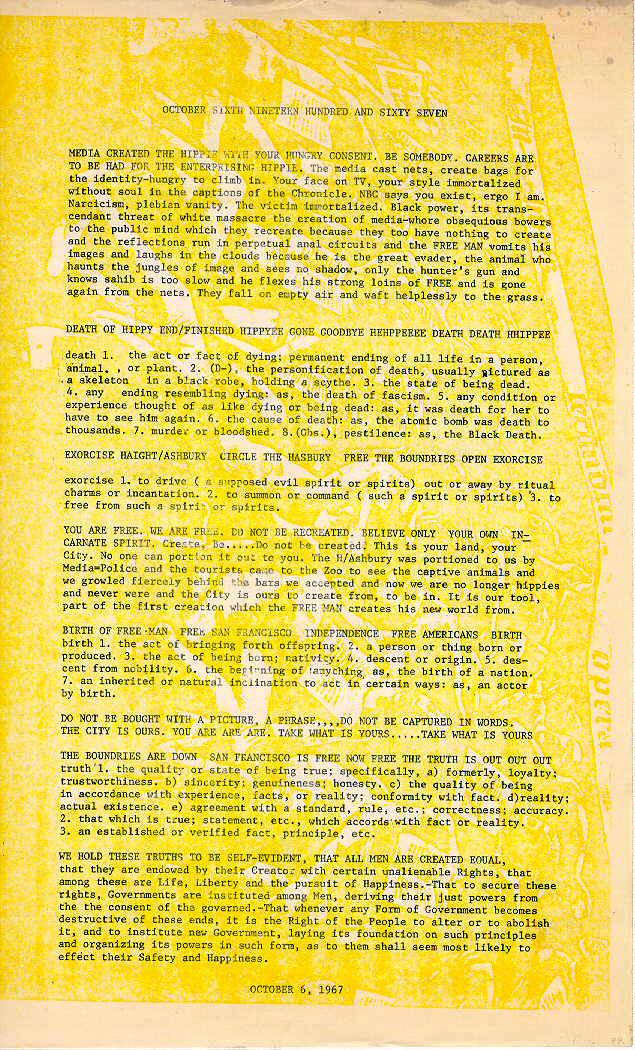 |
| 히피의 죽음 행렬에서 뿌려진 전단 |
 |
| 1967년 타임지 표지를 장식한 히피 |
MEDIA CREATED THE HIPPIE WITH YOUR HUNGRY CONSENT. BE SOMEBODY. CAREERS ARE TO BE HAD FOR THE ENTERPRISING HIPPIE. The media cast nets, create bags for the identity-hungry to climb in. Your face on TV, your style immortalized without soul in the captions of the Chronicle. NBC says you exist, ergo I am. Narcicism, plebian vanity. The victim immortalized. Black power, its transcendant threat of white massacre the creation of media-whore obsequious bowers to the public mind which they recreate because they too have nothing to create and the reflections run in perpetual anal circuits and the FREE MAN vomits his images and laughs in the clouds because he is the great evader, the animal who haunts the jungles of image and sees no shadow, only the hunter's gun and knows sahib is too slow and he flexes his strong loins of FREE and is gone again from the nets. They fall on empty air and waft helplessly to the grass.
DEATH OF HIPPY END/FINISHED HIPPYEE GONE GOODBYE HEHPPEEEE DEATH DEATH HHIPPEE
death 1. the act or fact of dying; permanent ending of all life in a person, animal, or plant. 2. (D-), the personification of death, usually pictured as a skeleton in a black robe, holding a scythe. 3. the state of being dead. 4. any ending resembling dying: as, the death of fascism. 5. any condition or experience thought of as like dying or being dead: as, it was death for her to have to see him again. 6. the cause of death: as, the atomic bomb was death to thousands. 7. murder or bloodshed. 8. (Obs.), pestilence: as, the Black Death.
EXORCISE HAIGHT/ASHBURY CIRCLE THE HASBURY FREE THE BOUNDARIES OPEN EXORCISE
exorcise 1. to drive (a supposed evil spirit or spirits) out or away by ritual charms or incantation. 2. to summon or command (such a spirit or spirits) 3. to free from such a spirit or spirits.
YOU ARE FREE. WE ARE FREE. DO NOT BE RECREATED. BELIEVE ONLY YOUR OWN INCARNATE SPIRIT. Create, Be.....Do not be created. This is your land, your City. No one can portion it out to you. The H/Ashbury was portioned to us by Media-Police and the tourists came to the Zoo to see the captive animals and we growled fiercely behind the bars we accepted and now we are no longer hippies and never were and the City is ours to create from, and to be in. It is our tool, part of the first creation which the FREE MAN creates his new world from.
BIRTH OF FREE-MAN FREE SAN FRANCISCO INDEPENDENCE FREE AMERICANS BIRTH
birth 1. the act of bringing forth offspring. 2. a person or thing born or produced. 3. the act of being born; nativity. 4. descent or origin. 5. descent from nobility. 6. the beginning of anything as, the birth of a nation. 7. an inherited or natural inclination to act in certain ways: as, an actor by birth.
DO NOT BE BOUGHT WITH A PICTURE, A PHRASE,,,,DO NOT BE CAPTURED IN WORDS. THE CITY IS OURS. YOU ARE ARE ARE. TAKE WHAT IS YOURS.....TAKE WHAT IS YOURS
THE BOUNDARIES ARE DOWN SAN FRANCISCO IS FREE NOW FREE THE TRUTH IS OUT OUT OUT
truth 1. the quality or state of being true; specifically, a) formerly, loyalty; trustworthiness. b) sincerity; genuineness; honesty. c) the quality of being in accordance with experience, facts, or reality; conformity with fact. d) reality; actual experience. e) agreement with a standard, rule, etc.; correctness; accuracy. 2. that which is true; statement, etc., which accords with fact or reality. 3. an established or verified fact, principle, etc.
WE HOLD THESE TRUTHS TO BE SELF-EVIDENT, THAT ALL MEN ARE CREATED EQUAL, that they are endowed by their Creator with certain unalienable Rights, that among these are Life, Liberty and the pursuit of Happiness.-That to secure these rights, Governments are instituted among Men, deriving their just powers from the consent of the governed.-That whenever any Form of Government becomes destructive of these ends, it is the Right of the People to alter or to abolish it, and to institute new Government, laying its foundation on such principles and organizing its powers in such form, as to them shall seem most likely to effect their Safety and Happiness.
OCTOBER 6, 1967
http://www.diggers.org/free_city_news_sheets.htm
Emily Elbert 노래
와. 잘 컸네! in the summertime 올렸을 때만해도 재능 넘치는 애기 같았는데. 특히 스릴러...
88년생이니 이제 20대 후반, 앨범도 많이 냈다. http://emilyelbert.bandcamp.com/
88년생이니 이제 20대 후반, 앨범도 많이 냈다. http://emilyelbert.bandcamp.com/
My Favorite Things - Brad Mehldau @ Jazz a Vienne 2010
브래드 멜다우는 옛날에 자영이가 소개시켜준 재즈 피아니스트다. 유러피안 재즈 트리오나 멜다우나...2000년대 초반만 해도 듣는 사람만 들었던 거 같은데 언젠가부터 카페에서 잘 틀어준다. 이런 종류의 음악을 쿨재즈, 모던재즈(?)라고 부른다. 머랄까 좀 신명나는 '밥' 느낌에 반해서 조용하고 차갑고 정돈됐고 멜랑콜리하다. 대표적인 예로 패트리샤 바버 같은 사람. 극도로 건반 터치를 아낀다. 이런 종류의 연주자는 팝음악의 클래식을 재즈 스타일로 재해석하길 즐긴다. 백인문화 계보란 소리.
오뉴월 토크 후기
오뉴월 아티스트 토크를 다녀왔다. 요샌 남의 말을 오래 듣고 있지 못하겠어서..토크 내용과는 별개로 엄청 지겨웠다. 끝나고 나서 중국 음식은 맛있었다.
오랫만에 민관씨를 만났다. 이런저런 이야길 나눴다. 여전히 긱한 느낌?
문혜진 선생도 만났다. 뭔가 호크다. 이미지가-.
강상훈 대표도 그렇고 김민관 기자도 그렇고...이 둘은 볼 때마다 뭔가 쪼글쪼글한 감이 생각난달까. 절대 노 오펜스, 그냥 이미지가 그렇다고.
전시에서 최현석 작가인가? 이름은 잘 모르겠다. 그분의 작업이 인상 깊어서 메모한다. (예전 개인전은 좀 시시했던 기억. 전시에 갔었는데 제대로 보지도 않았다.)
작업에서 작가는 스테이트먼트를 반복해서 읽는다. 다소 문어체의, 개념어로 뒤범벅된 글이다. 입에 안 익은 말이니 자꾸 틀린다. 틀리면 다시 처음부터 반복한다.
토크 내용을 들으니 작가에게 아티스트 스테이트먼트가 굉장히 중요하다고. 특히 공모 심사에서 제한시간 내에 작업을 압축적으로 설명하려면 그게 필요하다고 한다. 작가에 따르면, 항상 2차 면접 심사에서 떨어졌는데, 그때 작가는 작업 탓은 안 하고 스테이트먼트 탓을 한다고 한다. 그래서 몇번 아티스트 스테이트먼트를 수정하고 교정받고 해서 최고의 무기로 제련한다고 한다. 그걸 반복해서 암기한다고. 그걸 하느냐 안하느냐가 굉장히 차이가 많이 난다고 한다. 어쩌면 오늘날 젊은 작가들이 처한 현실을 솔직하게 이야기한 것일 테다. 여튼.
비디오에서 흥미로운 건 쓰여진 텍스트와 낭독자 사이의 미끌어짐이랄까. 계속 읽는데 잘 안된다. 근본적으로 잘 안맞기 때문이다. 도식적으론 이렇다.
예술가 vs. 언어 / 작업 vs. 스테이트먼트 / 예술 vs. (공모)제도
예술가, 작업, 예술의 편대는 언어와 제도에 적합한 형태로 재현되어야만 한다. 하지만 영상 속에서 그건 끊임 없이 미끌어진다. 영상은 그 대립항이 서로 겹쳐지면서 떨어지는 상황을 반복적으로 보여준다.
이건 크라우스의 <비디오: 나르시시즘 미학>에서 등장하는 세라의 폐쇄회로 작업관 좀 다른 차원에서 흥미롭다. 세라의 작업에서 퍼포머로 나선 그 여자(누군진 까먹었다)는 비디오가 만들어낸 심리적 감옥에 갇힌다. 끊임 없는 자기 참조 속에서 생각하길 정지한다.
하지만 이 작업에선 사회적으로 구성된 역할과 그것을 연기하려고 노력하는 진실한 자아가 동시에 매핑된다. 여기서 문제시되는 건 나르시시즘적인 매체 자체가 아니라 스테이트먼트를 요하는 제도와 예술가의 작업 사이에 형성되는 어떤 순환구조다. 좀 더 확장됐달까? 사용하고 있는 매체(비디오)까지 포함해서 성찰했면 좋았을텐데 그럼 작업이 복잡해졌으려나. 여튼 이런 류의 작업을 디벨롭했으면 좋겠단 생각을 했다.
또 홍정욱(?) 작가인가? 그분의 작업은 뭔지 잘 모르겠고, 말을 장황하게 하셨는데 이 전시와 관련해 흥미로운 포인트가 있어서 메모.
그분이 주로 말씀하셨던 건 기술적 문제였다. 원래 회화과 출신이라 입체를 만들 때 설계를 하고 어쩌고 저쩌고 실패를 줄이기 위해서 만전을 기한다고 하셨다. 고은씨가 이 작가의 작업실에 갔을 때 흥미를 느꼈던 게 그런 거 아닌가 싶다. 큐레이터는 작업을 안 실패하기 위해서 행하게 되는 준비 과정들, 그게 이 작가가 꽤나 탄탄했기 때문에 그걸 드러내고 싶었다고 볼 수 있겠는데, 사실 기계나 톱밥 같은 걸 리터럴리 그대로 가져오는 건 말도 안되고. 그 완성품이 만들어지는 조건. 즉 기술적 문제들이 프로세스 상에서 메인이 되니...그런 절차의 발명이 흥미로워보였던 게 아닐까. 추측.
임영주 작가도 마찬가지로 회화를 그리긴 했는데 세밀화 그리는 방법을 바꿔봤으면 좋겠다고 해서 그렇게 페인터리한 그림을 그렸다고 하고..전반적으로 그런 기술적 문제가 깔려있는 듯. 전시에서 그걸 드러냈으면 어땠을까 하는 생각도. 아. 이것도 한물 간건가? ㅎ
2015년 12월 10일 목요일
Save the Best for Last - Vanessa Williams
중학시절 일요일 낮 방에 누워 있었다. 뭔가 아저씨들이 듣는 라디오 프로그램이었던 것 같은데 그때 나왔던 노래다. 졸릴 때 들어서 뭔가 되게 신비한 느낌을 받았던듯. save the forest인 줄 알았는데 허허... 유튜브 검색해보니 무슨 그린피스 같은 게 나온다. 원제(?)는 save the best for last!
Kelly Blue - Wynton Kelly
윈튼 켈리의 곡을 몇 개 안 들어봤지만 그 중에서 젤 좋아하는 곡. 연습해본적이 있는 곡이어서 그런지 손가락의 움직임이 머리속에 그려진다는. 도입부에서 합을 맞추며 빰빠밤빠밤빠밤 할때가 시그니쳐!
미디어 폴리틱스
미디어 시대 정치인의 패러독스. 세심하게 설계된 (개인의) 캐릭터를 보여주되, 그것이 인공적인 느낌을 주면 안된다. 즉 시장에서 검증된 가짜 이미지를 마치 자연스러운 것처럼, 진솔하게 보여줘야 한다.
표면상으론 가짜 이미지를 부정하면서 실제론 그것을 해야 한다는 그런 이중속박. 필연적으로 분열증에 시달리게 된다. 그렇게 살고 싶은가? 여튼.
이건 일부 트위터 유저들에게서 자주 볼 수 있는 양태이기도 하다. 뻔한 말들을 가져다가 자기 말처럼 진정성있게 쏴대는. SNS 유저-대중의 입맛에 맞는 착착 감기는 말을 해줌으로써 유명세를 얻고 싶은.
한 마디 맞는 말 하려고 존나 고민한 다음에, 자연스럽게 아무생각 없이 한 마디 던진 것처럼 트윗-!
표면상으론 가짜 이미지를 부정하면서 실제론 그것을 해야 한다는 그런 이중속박. 필연적으로 분열증에 시달리게 된다. 그렇게 살고 싶은가? 여튼.
이건 일부 트위터 유저들에게서 자주 볼 수 있는 양태이기도 하다. 뻔한 말들을 가져다가 자기 말처럼 진정성있게 쏴대는. SNS 유저-대중의 입맛에 맞는 착착 감기는 말을 해줌으로써 유명세를 얻고 싶은.
한 마디 맞는 말 하려고 존나 고민한 다음에, 자연스럽게 아무생각 없이 한 마디 던진 것처럼 트윗-!
2015년 12월 9일 수요일
term Infinite regress
An infinite regress in a series of propositions arises if the truth of proposition P1 requires the support of proposition P2, the truth of proposition P2 requires the support of proposition P3, ... , and the truth of proposition Pn−1 requires the support of proposition Pn and n approachesinfinity.
Distinction is made between infinite regresses that are "vicious" and those that are not.
Goonies Good Enough (The True Colour Tour, Live in Paris, France 1987) - Cyndi Lauper
그래도 당시 아이돌이었을 텐데 삘 받으면 마..막춤을 자신감있게 시전하는 신디 로퍼. (오히려 최근엔 마돈나처럼 안무가 있는 춤을 구사하는 듯.)
주지하다시피 신디 로퍼는 80년대 마돈나와 쌍벽을 이룬 국민 여가수다. 마돈나가 좀 청순 가련(+섹시) 아이돌 느낌이면 로퍼는 머리부터 발끝까지 범상치 않은 말괄량이 삐삐. 패션은 무슨 니뽄 스타일을 참고했는지 이상한 레이어드 & 믹스매치. 길들여지지 않은 야생의 느낌이 물씬 풍긴다.
아무튼 막춤으로 무대를 휘젓고 다니는 모습을 보면 풋풋하다.
잊어야 한다는 마음으로 - 김광석
여러 가수의 버전을 들어봤는데 오리지널이 제일 낫네. 옛날 가수일 수록 목소리 자체에 호소력이 짙다. 속에 있는 걸 내뱉는 듯한, 혹은 '사람'이 부르는 듯한.
스카이 워커에 얽힌 사연
내가 처음 이사오 사사키를 첩한 건 어느 홈페이지에서였다. 지금 같은 블로그 서비스가 없던 시대라 개인이 운영하던 홈페이지가 많았던 그 때의 일이다. 홈페이지 제목이 MISSING YOU였는데 지금은 없어졌나보다. 그 당시로선 되게 예쁘게 만들어진 사이트였다.
이 아름다운 곡에는 에피소드가 붙어 있다. 한 여성의 풋풋한 짝사랑, 그것을 실현시켜주기 위한 소규모 음반 레이블의 시도.
물론 마케팅이었을지도 모른다. 아마 그랬겠지. 그때만 해도 지금처럼 계산적인 그런 느낌은 아니었다.
http://healingsori.tistory.com/45
[스크랩] HAL FOSTER on Interview

ABOVE: WRITER, THEORIST, AND TEACHER HAL FOSTER AT HOME IN NEW YORK, OCTOBER 2014. ALL CLOTHING AND ACCESSORIES: FOSTER'S OWN.
One of the most influential and dynamic thinkers on contemporary art in the past few decades is writer, critic, and Princeton professor Hal Foster. Often hiscritiques are founded in psychoanalytic theory, but time and again, Foster takes a more expansive approach, unwilling to limit his assessments or interests to those that fit comfortably into accepted models. Unlike so many academics, Foster's eyes seem open and fresh, and his focus extends beyond the safe, ossified codes of modernism. He has written on technology, feminism, the cyclical nature of art history, desire, the art of the mentally ill, and he has ventured far into the vortex of postmodernism. For this interview, ten artists and writers have each proposed a question for the brilliant Professor Foster to answer.
JEREMY DELLER: What was your first art epiphany?
HAL FOSTER: My first art epiphany is more like a primal scene because it has a traumatic touch and because it's a memory that mixes real and fictional bits. I was 12, and in the living room of an inseparable friend. Vast and uninhabited, it was composed like a picture in a magazine, appointed with furniture unlike any I had ever seen: elegant structures of aluminum tubes, glass tables so sheer they seemed to disappear. There were also objects that were not furnishings, which I understood to be sculptures, though they were not statues or busts. My friend called them abstract, which made the paintings on the walls, no less difficult to make out, abstract too. One painting in particular struck me; it was the most beautiful thing I had ever seen. A stack of hazy color in irregular blocks of paint, it was a bright apparition. At the top is a rectangle of white tinged with blue, a projection of pure light, and at the bottom, a bigger block of the same colors but in a different mix, like a midday sky shrouded with thin cloud. Below the white box on top is a yellow band almost covered by a red stripe, and below it is a final rectangle of cream, here underlined by streaks of all the colors that appear elsewhere on the canvas-blue, white, yellow, red. The painting is fire and ice at once, both calm and intense, and this is how it made me feel, too. About the size of a mirror or a window, it does not reflect anything or reveal any outside. It is its own appearance and perfect as such. "Yes, it's the most beautiful thing," I thought, and a second later, "Why do they have it and we don't?" The first flush of delight made me a devotee of art; the second rush of resentment made me a critic. Every critic needs a touch of ressentiment—it's his very salt—but too much produces embitterment.
DEVIN FORE: How do you write criticism that is critical? Even negative reviews seem to contribute to the market value of an artwork as long as they appear in the right journal. Is it possible to write about art without simultaneously valorizing it?
FOSTER: If it's not critical, it's not criticism; it's just commentary or opinion. That doesn't mean criticism has to be negative in the sense of pejorative; in fact, it can be affirmative if its negativity is clarifying—explosions clear the air! I don't write to be pejorative or positive in any case; that never motivates me. What gets me going is to grasp the new thing—an idea, an affect, some mix of the two—that a work expresses but doesn't articulate. That's the service I want to render: to limn that thing in words. I don't worry much about market valorization. Richard Serra and Cindy Sherman don't need me on that score. It was more dicey when I was a young critic writing about friends in the "Pictures" crew, but even then, dealers and collectors had far more power than critics. The days of agents like Clement Greenberg calling all the shots were long gone, and I was never much of a talent scout anyway. Besides, there's other valorization than the commercial, and critical value doesn't often convert to the economic. If it did, artists like Hans Haacke or Sharon Hayes or Hito Steyerl would be multimillionaires.
JEFFREY EUGENIDES: What makes each generation of artists different from those who came before? What percentage of the difference is conscious and what percentage unconscious? Finally, is a consciously achieved difference better than an unconscious one, or doesn't that matter?
FOSTER: If I had the answer to this one, I'd have the algorithm for all of art history; what I have to say isn't very satisfactory. First up is initiation into history, which can't help but form generations differently, obviously enough. Next is entry into art, which is more voluntary. For American artists and critics of the generation before my own, Pollock was the great figure; he sent them off in certain directions. The art that most marked people like me was minimalism or pop (especially Warhol) or both, and that drove us in ways other than the Pollock pathways. Implicit here is a familiar take on influence à la Harold Bloom, and the ratio of conscious to unconscious in his tale of artistic anxiety is tough to measure. That story is also very Oedipal, and one contribution of feminist artists was to challenge all such boyish genealogies. That said, every artist has to deal with predecessors. It only becomes a problem when that vying becomes too conscious, that is, too strategic. Duchamp was so generative, but the many people who took his chess metaphor literally, and thought that if they worked out the next move before anyone else did, they'd win—well, they didn't and they don't (or if they do, it's only for a season or two). The difference that makes a difference in generations is always unexpected, it's a working through that mixes the conscious and the unconscious, and the one is not better than the other. (Like I said: not very satisfactory.)
WADE GUYTON: Is there anything you've written or said that you'd like to take the opportunity now to recant? (Don't worry, we probably won't hold it against you.)
FOSTER: I'd suggest trial by fire. If I don't burn, then I'm innocent. Art criticism is small beer; it's not like it offers the chance for much in the way of heresy. So not much to recant, but some to regret. Along with many others, I ate up theory like it was hash brownies, and I still do, but I'm more careful about what I write when I'm theoretically high. Also, when I was a young critic, I printed some hurtful things. I once wrote of a painter that he was "Lichtenstein without the pop." I thought it was clever; he thought it was cruel, and later told me it had devastated him. Even if it is true, a line that cuts someone seems gratuitous to me, and I'm certain there are many others who were victims of my mistaking the rhetorical for the critical. I'm still too much a sucker for a facile formulation. (I almost wish I had written stuff I could recant now. I'll try to do worse in the future.)
THOMAS HIRSCHHORN: Explain why questions-and-answers is the most important part of a lecture.
FOSTER: I bet I know why it is for you: You like to get close to the attacking parties and have at them. Me, not so much. I almost always come up with the right response too late, by a day or two anyway. Yet the back-and-forth doesn't have to be agonistic, and it can produce new thought precisely because it is dialogical—not yours, not theirs, but made together in the moment. That can be exciting. The problem is I rarely remember what was said afterwards. I suppose that's part of why it's good, though: that it's effervescent, that it's about a brief connection even (or especially) if that connection crackles with opposition, a momentary community libidinized by thinking.
TACITA DEAN: A swinish question: How do you perceive your relationship to established power?
FOSTER: I don't feel subversive, but then I don't feel corrupt either. As a young critic, I was phobic about the market until Barbara Kruger said to me one day, "There is nothing, not even the lint on your sweater, that's not touched by the market. Get over it." By which she meant: find a realistic relation to it; fantasies of a pure outside aren't helpful. Still, I have more than a trace of Romantic anti-capitalism in me. I think most leftish people do. It comes with being a kid in the 1960s, and then emerging as a critic in the 1980s, with Reagan, deregulation, the sheer awfulness of what we now call neoliberalism. Wall Street money suddenly washed over the art world, which was changed utterly, and independent space for critical work shrunk dramatically. I was an editor at Art in America at the time, and the market reformatted everything before our eyes. I ran to the academy as if it were a sanctuary, which it was—there was a short period when the humanities were taken by critical theory. But I soon discovered you're as much a commodity there as anywhere else. The university does screen you from power, however; my own is bound up with governments and corporations in ways both good and bad, but it affects me little either way. The art world is far more naked in its involvement with power. At dinners after openings I sometimes feel like I'm watching bank accounts have sex. But as I mentioned in response to Devin, I'm a very small chip in the casino that is the art world.
SETH PRICE: I mostly make visual art, but at the same time I feel that music is the best art form, and sometimes I think you can accomplish the most within the field of literature. Do you ever feel the limits of your own work, in terms of either visual art as a focus or of history and criticism more generally?
FOSTER: I agree about music. Gerhard Richter says somewhere that painting is fine, but it's music that brings you to your knees. (I wonder if that's always a good thing.) And I read more literature than I do criticism, history, or theory. I review it sometimes, too. I always wanted to write fiction; I'm just not good at it, and I respect it too much to make a mess of it. Besides, criticism, it should be remembered, was the cutting edge of the culture when I was formed in the 1970s: Who was more vanguard than Susan Sontag and Rosalind Krauss, and more ass-kicking to boot? As for the limits of my own work, I feel them all the time. My prose has little range (Caesar the ape has a bigger vocabulary than I do), and it's about as supple as that of my Puritan ancestors, but then, like them, I think limits are good. Creative people require the recalcitrance of the medium they work in; its pushing back is what pushes them on. What keeps me going is the interplay between art, criticism, theory, and history; they're never opposed for me. Art is theoretical in its own way, and theory is artful. Criticism that's not historically minded sucks, and history that's not critically spirited is beside the point.
RIVKA GALCHEN: You've thought and written extensively about the avant-garde's relation to and resistance to capitalism, about the real, the replica, the readymade, and about the relation of criticism to the instinct to possess. Given all that, I wanted to ask what is your favorite heist film, and why?
FOSTER: To Catch a Thief [1955]. It has all of the above (resistance to capital, instinct to possess, etc.), plus Cary Grant and Grace Kelly. How not to identify with that guy—his black pullover, his silvery hair, his fake-classy accent? And to have Grace all over you, the Ice Queen melting in your arms, as you get in and out of jams with total aplomb, outfoxing everyone, screwing French bureaucracy along the way. It's also an allegory of criticism, at least of the deconstructive sort. The best criticism is an inside job. You can't rely on the authorities; you have to know the enemy better than he knows himself. It takes a thief to apprehend one. Immanent critique is all about going in through a rooftop or a side window, and not nabbing the jewels (who cares about meaning?) but catching the thief (anyone who believes he knows the one true significance).
RACHEL KUSHNER: You and I were having an e-mail exchange a while back about the German Romantic notion of integrated civilizations and Lukács. I referenced that famous line about philosophy being really homesickness, "The urge to be at home everywhere." And you said, compellingly, enigmatically, "Homelessness is such a beautiful idea. It's in art too: that's what abstraction is, in a way." Can you say more about homelessness in art, in abstraction?
FOSTER: I love it: Lukács in Interview! I wonder how he'd do at the Factory. Is there a more beautiful overture to a book than the one in his Theory of the Novel? "Happy are those ages when the starry sky is the map of all possible paths—ages whose paths are illuminated by the light of the stars. Everything in such ages is new and yet familiar, full of adventure and yet their own. The world is wide and yet it is like a home, for the fire that burns in the soul is of the same essential nature as the stars ..." It is this consanguinity of star and soul that is broken by modernity, in which "artistic creation has become homeless." But then, to spin it around, who wants the old home of an "integrated civilization" anyway? My sense of the homelessness of modernist art is almost positive. Free to go where it wants, but under the compulsion to motivate what it does, for otherwise it would be arbitrary. That is its beauty, especially when it comes to abstract painting. No referent to anchor it, so where will it sail? To the depth of the psyche? To a transcendental world? To the medium itself? Lukács was more dire. And if you can grasp this koan of his, you'll have one key to modernist art (and he wrote this in 1914!): "A totality that can be simply accepted is no longer given to the forms of art: therefore they must either narrow down and volatilize whatever has to be given form to the point where they can encompass it, or else they must show polemically the impossibility of achieving their necessary object and the inner nullity of their own means. And in this case they carry the fragmentary nature of the world's structure into the world of forms."
THOMAS DEMAND: Biggest misconception? Regrets? Worst Halloween costume? What's on your refrigerator? When at the top of the hill, is it better to be alone or with others?
FOSTER: My biggest misconception was that critical theory would be the continuation of the avant-garde by other means. As for regrets, I mentioned some in my response to Wade, but I also regret every single Halloween costume. Usually I go as myself, which is the worst. As for the refrigerator, my prize items are a postcard of a blond girl in the Swiss Alps captioned "Heidiland" and the BlackSquare of Malevich. Lesson 1: Climb every mountain, sing every song. Lesson 2: Believe.
Thomas Hirschhorn is a Paris-based artist represented by Gladstone Gallery in New York. His site-specific installation Höhere Gewalt was presented at the Schinkel Pavillon this past summer.
Devin Fore teaches at Princeton University. His first book, Realism After Modernism, won the Modern Language Association's prize for best book in German studies. In 2014, he was awarded fellowships from the John Simon Guggenheim Memorial Foundation and the American Council of Learned Societies to complete a study of Soviet documentary.
Wade Guyton is a New York-based artist represented by Petzel Gallery in New York. His work Zeichnungen für ein kleines Zimmer is on view in the Cube of Punta della Dogana/François Pinault Foundation in Venice through December. He has a solo exhibition at the Josef Albers Museum in Germany open through February 2015.
Jeffrey Eugenides was born in Detroit and lives in Princeton, New Jersey, where he teaches at Princeton University. He is the author of Middlesex, which won the 2003 Pulitzer Prize and was shortlisted for the National Book Critics Circle Award; The Virgin Suicides; and most recently, The Marriage Plot.
Jeremy Deller is a London-based, Turner Prize-winning artist represented by Gavin Brown's enterprise in New York. He recently curated the show "Love Is Enough," which brings together rarely seen works by William Morris and Andy Warhol. It opens at Modern Art Oxford in December 2014.
Tacita Dean is a Berlin-based artist represented by Marian Goodman Gallery in New York. She is currently an artist-in-residence at the Getty Research Institute in Los Angeles and has a work in "The Dying of the Light: Film as Medium and Metaphor" at the Massachusetts Museum of Contemporary Art on view through February 2015.
Seth Price is a New York-based artist who works with a wide range of media. His recent monograph, Folklore U.S., explores a series of works made between 2012 and 2014. Price's exhibition "Animation Studio" is on view at Galerie Chantal Crousel in Paris through December 2014. He is represented by Petzel Gallery in New York.
Rivka Galchen is a Canadian-American writer based in New York. She is the author of the novel Atmospheric Disturbances and, more recently, the short-story collection American Innovations.
Rachel Kushner is the author of The Flamethrowers and Telex From Cuba. The Strange Case of Rachel K, a book of early writing, is out from New Directions in February 2015. Her fiction and essays have appeared in The New Yorker,Harper's, The Paris Review, and elsewhere. She lives in Los Angeles.
Thomas Demand is a German artist based in Berlin and Los Angeles. He has had a number of solo exhibitions, including at the Museum of Modern Art, New York. His film Pacific Sun is on view at the Los Angeles County Museum of Art through April 2015 and will run concurrently with a solo exhibition of new work opening in January at Matthew Marks Gallery, Los Angeles.